SAP Insiders
Articles/Artificial Intelligence/Every Major AI Model in 2025–2026 — GPT, Claude, Gemini, Llama, DeepSeek and 25 More
Artificial Intelligence

Every Major AI Model in 2025–2026 — GPT, Claude, Gemini, Llama, DeepSeek and 25 More

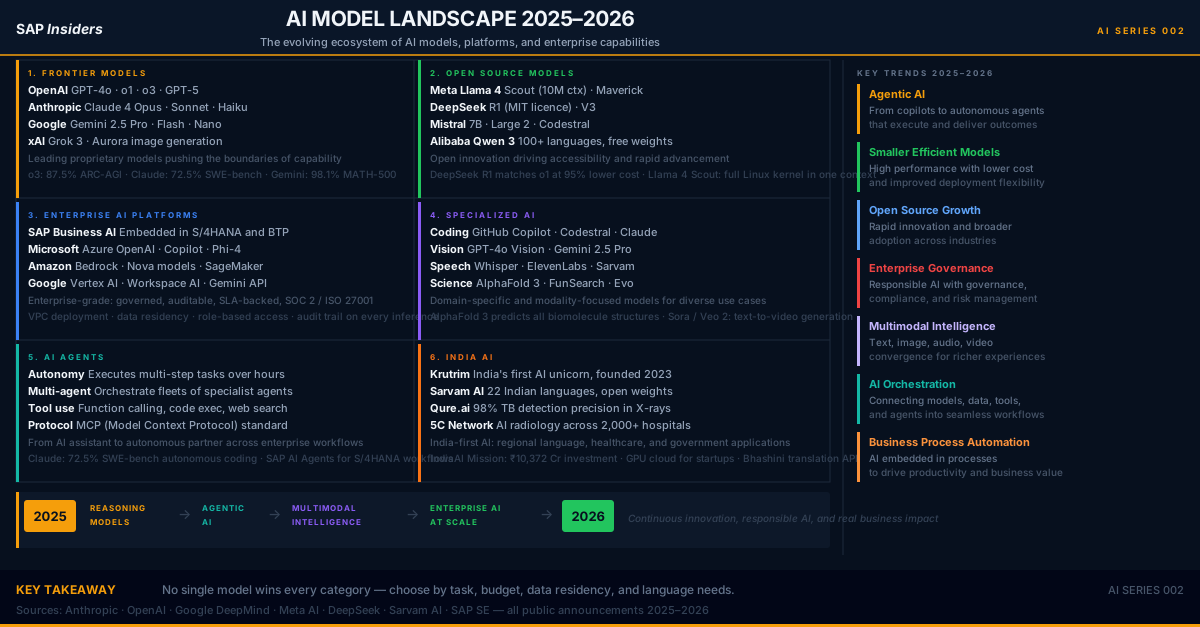
There are now more than 50 significant AI models in active production use. This is the definitive reference: every major model from OpenAI, Anthropic, Google, Meta, DeepSeek, Mistral, xAI, Alibaba, and India's own Krutrim and Sarvam AI — what each was built for, who built it, what it costs, and how to choose the right one for your task.
Editorial magazine infographic — Every Major AI Model 2025-2026. Dark tech background with six organisation columns: OpenAI (orange), Anthropic (teal), Google (blue), Meta (green), Open Source (purple), India (saffron). Each column lists key models with context window and specialty tags. Bottom bar: KEY TAKEAWAY — the right model depends on your task, your budget, and whether you need to run it yourself.

In 2022, there were three AI language models worth knowing: GPT-3, a research model from Google called PaLM, and early LaMDA. In 2025, there are more than 50 significant models in active production use, spanning six major organisations, three continents, and every price point from free open weights to ₹7 per thousand words.

This is the reference you need: every model that matters, what it was built for, and how to choose.


How to Read This Article

Closed models are run by the company that built them — you access them through an API or product interface, and the company controls the weights, training data, and pricing. OpenAI, Anthropic, and Google run closed models.

Open-weight models are released with their weights publicly available — you can download, run, and modify them. Meta, Mistral, DeepSeek, and Alibaba have released open-weight models. This matters enormously for enterprises: you can run an open-weight model inside your own infrastructure, with no data leaving your servers.

Context window is how much text the model can "see" at once — its working memory. Larger is better for complex, multi-document tasks. The evolution from 4,000 tokens (GPT-3) to 10,000,000 tokens (Llama 4 Scout) happened in four years.

Benchmark caveat: Benchmarks measure specific capabilities under controlled conditions. A model that tops MATH-500 may still struggle with your specific task. Use benchmarks for rough ranking; test on your actual use case before committing.


OpenAI — The Company That Changed Everything

OpenAI launched ChatGPT in November 2022 and triggered the current AI race. Their model lineup spans general language, reasoning, image, video, and speech.

GPT-4o — The Everyday Workhorse

Released May 2024. The "o" stands for omni: text, image, and audio in a single model. GPT-4o can see an image you send, hear your voice in real time, and respond in kind — all within one unified model rather than stitching separate systems together. It is faster and significantly cheaper than GPT-4 Turbo.

Best for: Conversational AI products, content generation, coding assistance, multimodal tasks (describe this image, explain this chart). For most everyday tasks, GPT-4o is OpenAI's flagship recommendation.

Context window: 128,000 tokens (~300 pages of text)


o1 / o3 / o4 — The Reasoning Series

Released September 2024 (o1), December 2024 (o3). These models spend compute thinking before answering — they run an internal chain-of-thought that is hidden from the user, exploring multiple approaches before settling on a response.

The result is dramatically better performance on problems that require step-by-step reasoning: complex mathematics, competitive programming, graduate-level science. o3 scored 87.5% on the ARC-AGI benchmark (a test of general intelligence), compared to the human average of around 85%.

Best for: Hard math problems, competitive coding, scientific analysis, any task where a wrong answer is worse than a slow answer.

Important trade-off: o-series models are 5–10× slower and more expensive than GPT-4o. For a customer service chatbot or a content summary, they are overkill.


GPT-4.5 and GPT-5

GPT-4.5 (February 2025): More capable than GPT-4o on general knowledge, with improved emotional intelligence and conversational naturalness. Very expensive — intended for applications where quality justifies cost.

GPT-5 (2025): Unifies reasoning and general capabilities into a single model. Leads on creative writing benchmarks in early 2026 evaluations.


Specialised OpenAI Models

OpenAI builds more than language models. Three specialised models extend their platform into image, speech, and video — each now embedded in products used by hundreds of millions of people.

Specialised OpenAI Models — DALL-E 3 image generation, Whisper speech recognition in 99 languages including Hindi Tamil Telugu, Sora video generation 60-second clips

ModelTypeWhat It Does
DALL-E 3Image generationText-to-image, integrated into ChatGPT and Copilot
WhisperSpeech recognitionOpen-source, state-of-the-art transcription in 99 languages including Hindi, Tamil, Telugu
SoraVideo generationText-to-video; produces 60-second clips

Anthropic Claude — Built With Safety at the Core

Anthropic was founded in 2021 by Dario Amodei, Daniela Amodei, and others who left OpenAI over disagreements about safety practices. Claude is trained using Constitutional AI — a set of principles the model uses to self-evaluate its own outputs, making it less likely to produce harmful content even under adversarial prompting.

The Claude Family — Four Generations

ModelReleasedKey CapabilityContext
Claude 3 HaikuMar 2024Fast and cheap — high-volume tasks200,000
Claude 3 SonnetMar 2024Balanced speed and quality200,000
Claude 3 OpusMar 2024Most capable at launch — complex reasoning200,000
Claude 3.5 SonnetJun 2024Beat all GPT-4 class models on coding at launch200,000
Claude 4 SonnetMay 202572.7% on SWE-bench coding; hybrid reasoning mode200,000
Claude 4 OpusMay 202572.5% SWE-bench; best for autonomous multi-hour tasks200,000
Claude Sonnet 4.6Jul 2025Current production model; 98% of Opus quality at fraction of cost200,000

Claude 4 Opus can work autonomously on complex tasks for hours — running code, browsing files, running tests, iterating on its output — making it the current leader for agentic workflows where the AI operates more like a junior engineer than a chat partner.

Unique Claude advantage: 200,000-token context window across all models means Claude can read an entire large codebase, a full financial report, or a book-length document in one pass. For SAP consultants or finance teams working with long documents, this matters more than benchmark rankings.


Google Gemini — Native Multimodality and the Context Window Race

Google DeepMind merged their two AI research groups (Brain and DeepMind) in 2023 and released the Gemini series. Google's unique advantage: native multimodal reasoning (text, image, video, code, audio processed together from day one), and the deepest integration with Google Search, YouTube, and Workspace.

Gemini Model Lineup

ModelContextPricing (per 1M tokens)Standout
Gemini 1.5 Pro1,000,000$1.25 / $5.00First 1M-token window — entire codebases in one pass
Gemini 2.0 Flash1,000,000$0.10 / $0.40Ultra-cheap, fast, agentic tasks
Gemini 2.5 Flash1,000,000$0.30 / $2.5084.0% MMMU, 98.1% MATH-500; thinking budget control
Gemini 2.5 Pro2,000,000$1.25 / $10.00Leads LiveCodeBench; 2M tokens

Gemini 2.5 Pro has a 2 million token context window — the largest of any frontier model. That is roughly the equivalent of reading 50 full-length novels and then answering detailed questions about all of them.

Gemini Nano: A tiny version running directly on Android devices. Powers real-time transcription, smart reply, and spell-check on Pixel phones without sending data to Google's servers.


Meta Llama — Open Source as a Strategic Weapon

Meta's decision to release Llama model weights publicly is one of the most consequential moves in AI history. The reasoning is partly altruistic and partly strategic: if the world builds on Llama, Meta shapes the default infrastructure of AI. It is the same strategy Red Hat used with Linux.

Llama Family

ModelReleasedKey Facts
Llama 2Jul 2023Benchmark-competitive with Gemini 1.0 Pro. 13B, 70B variants. Free for commercial use.
Llama 3Apr 20248B and 70B. Significantly better than Llama 2. 128K context.
Llama 3.1 405BJul 2024405 billion parameters. Competitive with GPT-4o. Truly open-weight.
Llama 3.3 70BDec 202470B model matching 405B quality through improved training.
Llama 4 ScoutApr 2025Natively multimodal (text + image). 10 million token context. MoE architecture.
Llama 4 MaverickApr 2025Larger MoE model — outperforms GPT-4.5 on STEM benchmarks.

Llama 4 Scout's 10 million token context window is extraordinary. At that context size, the model can read the entire source code of a large enterprise application — including all comments, history, and documentation — in a single inference call.

Why open weights matter for India: Indian enterprises and government bodies that cannot send sensitive data to foreign servers can run Llama 4 on their own infrastructure. The RBI, UIDAI, and defence ministries all have data residency requirements that make open-weight models not optional but necessary.


DeepSeek — The Sputnik Moment

On 20 January 2025, a Chinese startup called DeepSeek released DeepSeek R1 under the MIT Licence — unrestricted commercial use, free to download, free to modify.

The shock: DeepSeek R1 matched OpenAI's o1 on mathematics and coding benchmarks. Specifically: 97.3% on MATH-500 (near perfect), comparable scores on AIME and Codeforces to o1. The cost to run it: approximately 95% less than equivalent OpenAI models.

NVIDIA's stock dropped 17% in a single day. Not because DeepSeek had done something illegal — but because it suggested frontier AI may not require the compute scale (and therefore the GPU hardware) that Wall Street had assumed.

How they did it: DeepSeek uses a Mixture of Experts (MoE) architecture: instead of activating all 671 billion parameters for every token, only 37 billion parameters are active at any given time. The model routes each token to the experts most relevant for that token. Efficient routing + careful training = frontier performance at a fraction of the compute cost.

DeepSeek Model Lineup

ModelSpecialityNotable Fact
DeepSeek V2GeneralFirst model to shock western labs with cost-efficiency
DeepSeek V3General671B params, 37B active. Competitive with GPT-4o
DeepSeek R1ReasoningMIT licence. Matches o1 at 5% cost.
DeepSeek V3-0324GeneralUpdated V3 with improved instruction following

Mistral — Europe's Answer

Paris-based Mistral AI, founded in 2023, has produced models that consistently outperform models twice their size — proving that architecture efficiency matters more than raw parameter count.

ModelReleasedStandout Feature
Mistral 7BSep 2023Outperformed Llama 2 13B at half the parameters using sliding window attention
Mixtral 8x7BDec 2023First major open-source MoE: 8 experts, 2 active = 13B active / 47B total. Near GPT-3.5 quality.
Mistral Large 22024Flagship. Competitive with GPT-4 class.
Codestral2024Fine-tuned for code generation and completion. Best in class for Python and JS.
Mistral Small 3.12025Compact but capable. Good for on-premise deployment.

Why Mistral matters: European AI sovereignty. Models trained under GDPR constraints, hosted in EU data centres. For European and Indian enterprises with strict data residency rules, Mistral offers an alternative to US-controlled models.


xAI Grok — The Realtime Web Model

Elon Musk's xAI launched Grok in November 2023, with a key differentiator: realtime access to X (Twitter) data. Every other major LLM has a training cutoff; Grok has a live feed to current events.

ModelNotes
Grok 1Open-weight, 314B MoE. Released under Apache 2.0.
Grok 2Frontier-class, closed API. Image understanding.
Grok 32025. "Thinks before answering." Competes with o1 on reasoning.

Best for: Journalists, researchers, and social media analysts who need responses grounded in today's news rather than a training cutoff.


Alibaba Qwen — The Multilingual Champion

Alibaba's Qwen series is the strongest open-weight model for multilingual tasks — particularly important for Indian regional languages.

ModelContextStandout
Qwen 2.5 72B128KOutperforms models of similar size on coding, math, multilingual
Qwen 3 235B-A22B128KMoE. 88.4% on GPQA Diamond — exceeds many closed frontier models. Supports 100+ languages.

India relevance: Qwen's multilingual training includes stronger coverage of Indic scripts than most western models. For Bengali, Gujarati, Tamil, Telugu processing tasks, Qwen 3 often outperforms Llama and Mistral.


Microsoft Phi — Small But Surprisingly Capable

Microsoft Research's Phi series challenges the assumption that bigger is always better.

ModelParamsStandout
Phi-3 Mini3.8BFits on a smartphone. Matches GPT-3.5 on many benchmarks.
Phi-414BBest-in-class small model. 84.8% on MATH-500. Runs locally.

Use case: On-premise deployment in constrained environments — hospital workstations, factory floor terminals, government offices — where a full GPU cluster is not available and cloud API calls are not permitted.


Specialist Models — Beyond Language

Reasoning

  • OpenAI o3: Best reasoning model as of H1 2025 for complex math, science, and logic
  • DeepSeek R1: Open-weight reasoning at 5% of o3 cost
  • Gemini 2.5 Pro: Thinking mode with budget control — you set how long it "thinks"

Image Generation

ModelProviderNotes
DALL-E 3OpenAIIntegrated into ChatGPT. Good prompt adherence.
Midjourney v6MidjourneyBest aesthetic quality. Subscription only, no API.
Stable Diffusion 3.5Stability AIOpen weights. Run locally. Best for custom fine-tuning.
Flux 1.1 ProBlack Forest LabsExcellent text rendering in images — a historic weakness of image AI.
Adobe FireflyAdobeCommercially safe (trained on licensed data). Built into Photoshop.
Imagen 3GoogleGoogle's flagship image model. Part of Gemini ecosystem.

Video Generation

ModelProviderNotes
SoraOpenAIUp to 60-second HD clips.
Veo 2Google DeepMindCinematic quality. Part of Workspace integration.
KlingKuaishouChinese competitor. Strong at realistic motion physics.

Coding

ModelNotes
GitHub Copilot (powered by GPT-4o)Inline code completion inside VS Code, IntelliJ. 50,000+ enterprise customers.
Cursor (powered by Claude 4 Sonnet)IDE built around AI — entire codebase context, multi-file edits.
Codestral (Mistral)Open-weight code specialist — best for European on-premise deployments.

Science

ModelNotes
AlphaFold 3 (Google DeepMind)Predicts 3D structure of proteins, DNA, RNA. Has accelerated drug discovery by years.
Med-PaLM 2 (Google)Medical question answering at expert-physician level on USMLE.

Indian AI — Built at Home

CompanyModelNotes
Krutrim (Ola)Krutrim LLMIndia's first AI unicorn. 2 million users in 8 weeks. Indian language focus.
Sarvam AISarvam-1, Saarika, BulbulPurpose-built for 22 Indian languages. Open-weight. Speech + text. Saarika: voice AI. Bulbul: text-to-speech.
CDAC / AIIMSiOncology.aiAI for cancer detection on radiological images. Deployed in government hospitals.
Qure.aiqXR, qCTAI radiology. Deployed across India and 50+ countries. 98% precision on TB screening.

Sarvam AI is particularly significant: a startup built specifically to serve India's linguistic diversity, with models trained on Assamese, Bengali, Gujarati, Hindi, Kannada, Malayalam, Marathi, Odia, Punjabi, Tamil, and Telugu alongside English — and released as open weights for Indian enterprises.


Context Window Evolution — The Working Memory Race

Bar chart showing context window growth from 2020 to 2025. Bars in ascending order: GPT-3 4000 tokens in 2020, GPT-4 128000 in 2023, Claude 3 200000 in 2024, Gemini 1.5 Pro 1 million in 2024, Gemini 2.5 Pro 2 million in 2025, Llama 4 Scout 10 million in 2025. Chart title: The Context Window Race — from 4,000 to 10,000,000 tokens in five years.

YearModelContext WindowWhat Fits Inside
2020GPT-34,000 tokensA short article
2023GPT-4128,000 tokens300 pages of text
2024Claude 3200,000 tokensA full novel
2024Gemini 1.5 Pro1,000,000 tokens2,500 pages — entire codebase
2025Gemini 2.5 Pro2,000,000 tokens5,000 pages — multiple large codebases
2025Llama 4 Scout10,000,000 tokensThe entire Linux kernel source code

How to Choose: The Right Model for Your Task

TaskBest ChoiceWhy
Everyday writing and summarisationGPT-4o or Claude Sonnet 4.6Best cost-performance balance
Complex coding, agentic tasksClaude 4 OpusLeads SWE-bench; works autonomously
Hard math and scienceo3 or Gemini 2.5 ProReasoning mode purpose-built for this
Long document analysisClaude 4 or Gemini 2.5 Pro200K–2M token context
Cost-sensitive / high volumeDeepSeek V3, Gemini 2.0 FlashFrontier quality at fractions of GPT-4o cost
On-premise (data stays in your server)Llama 4, Mistral, DeepSeek R1Open weights — self-host
Indian languagesSarvam AI, Qwen 3Specific Indic language training
Image generationMidjourney v6 (art), DALL-E 3 (product)Different aesthetic strengths
Video generationSora, Veo 2Similar quality; Sora has API
Realtime news / current eventsGrok 3Live X data feed
Protein folding / drug discoveryAlphaFold 3Nothing else competes

What It All Means

The AI model landscape of 2025–2026 is not one horse race — it is six parallel races. OpenAI leads on product experience and ecosystem. Anthropic leads on safety research and autonomous agent capability. Google leads on context window and multimodal depth. Meta has made open-source mainstream. DeepSeek proved that compute efficiency can neutralise a $100 billion advantage. And Mistral, Qwen, Sarvam, and Krutrim are demonstrating that frontier AI is not the exclusive property of Silicon Valley.

The practical implication: for most tasks, you now have options across every price point, every data residency requirement, and every language. The question is no longer "can AI do this?" but "which AI, deployed how, at what cost?"

The next article in this series covers how to evaluate and test any model for your specific use case — before committing to a production deployment.


Quick Reference — All Major Models

ModelOrganisationTypeContextBest For
GPT-4oOpenAIClosed128KGeneral, multimodal
o1 / o3OpenAIClosed128KReasoning, math
GPT-5OpenAIClosed128KGeneral flagship
Claude 4 SonnetAnthropicClosed200KCoding, balanced
Claude 4 OpusAnthropicClosed200KAutonomous agents
Claude Sonnet 4.6AnthropicClosed200KCost-effective daily use
Gemini 2.5 FlashGoogleClosed1MFast, affordable
Gemini 2.5 ProGoogleClosed2MLong context, multimodal
Llama 4 ScoutMetaOpen10MOpen, massive context
Llama 4 MaverickMetaOpen1MOpen, STEM
DeepSeek R1DeepSeekOpen64KReasoning, free
DeepSeek V3DeepSeekOpen128KGeneral, low cost
Mistral Large 2MistralClosed128KEuropean compliance
Mixtral 8x7BMistralOpen32KOn-premise, MoE
CodestralMistralOpen32KCode specialist
Grok 3xAIClosed131KRealtime news
Qwen 3 235BAlibabaOpen128KMultilingual, Indian scripts
Phi-4MicrosoftOpen16KOn-device, constrained
DALL-E 3OpenAIClosedImage generation
Midjourney v6MidjourneyClosedArt-quality images
Stable Diffusion 3.5Stability AIOpenCustom image fine-tuning
SoraOpenAIClosedVideo generation
Veo 2GoogleClosedVideo generation
WhisperOpenAIOpenSpeech transcription, 99 languages
AlphaFold 3Google DeepMindClosedProtein structure prediction
KrutrimKrutrim/OlaClosedIndian languages, India-only
Sarvam-1Sarvam AIOpen22 Indian languages

Sources: Anthropic public blog (Claude 4 announcement, May 2025); OpenAI system cards (GPT-4o, o3); Google DeepMind (Gemini 2.5 technical report); Meta AI (Llama 4 release notes); DeepSeek technical report (January 2025); Mistral AI documentation; Vellum LLM Leaderboard (2026 edition); Artificial Analysis model comparison (June 2026); Sarvam AI press release (2025); Krutrim launch announcement (2024). Benchmarks: MATH-500, MMMU, SWE-bench, GPQA Diamond, LiveCodeBench sourced from respective technical reports.