Vadodara, Gujarat. 30 November 2022. Ravi Shankar, a 28-year-old software engineer, types a question into a new website called ChatGPT at 11:45 PM. He asks it to explain recursion in three different ways — formal, simple, and as a funny story. The answer comes back in four seconds, perfectly calibrated to each style. He calls his friend. "Yaar, this changes everything."
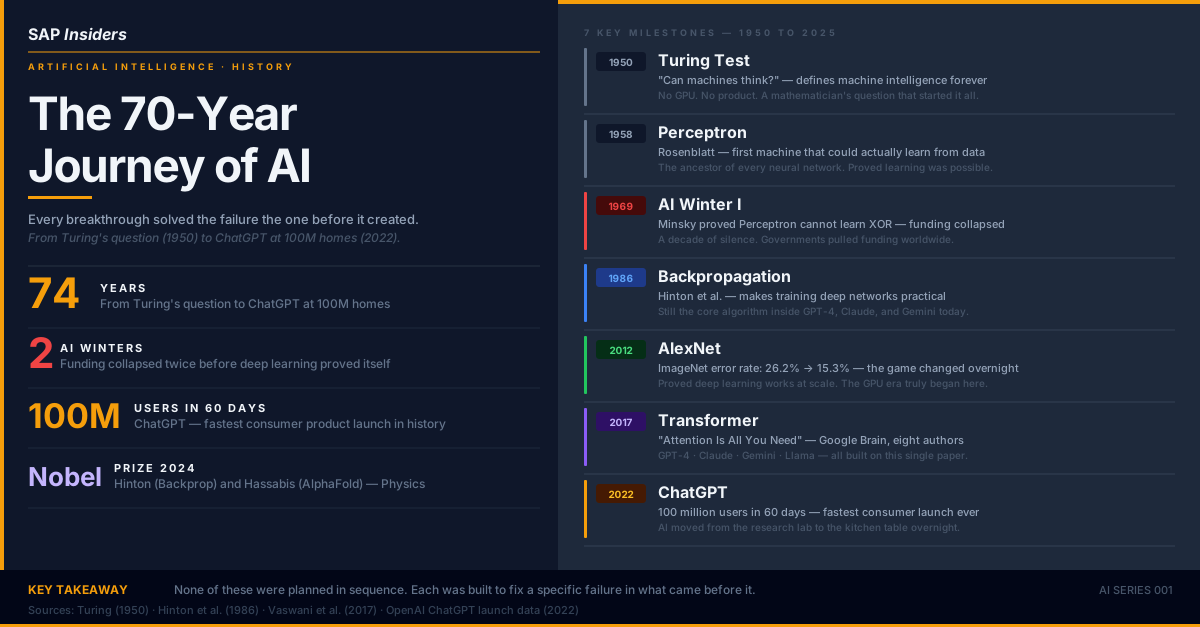
He was right. ChatGPT hit 100 million monthly active users in 60 days. No product in history had grown that fast — not Instagram (2.5 years), not TikTok (9 months), nothing.
But that four-second response didn't come from nowhere. It was the result of 74 years of mathematics, two complete funding collapses, and a 2017 paper written in Google's cafeteria that quietly changed the direction of civilisation.
Here is the complete story.
1950: The Question That Started Everything
Alan Turing was not a businessman. He was a British mathematician who spent the Second World War breaking Nazi codes at Bletchley Park. In 1950, five years after the war ended, he published a paper titled "Computing Machinery and Intelligence" that opened with the most consequential question in the history of technology:
"Can machines think?"
Turing knew the question was philosophically slippery — "thinking" is notoriously hard to define even for humans. So he proposed a practical test: place a human and a machine in separate rooms, and let a judge exchange text messages with both. If the judge cannot reliably tell which is the machine, the machine passes.
This is the Turing Test. For decades it was dismissed as a parlour trick. In 2023, GPT-4 consistently passed it in controlled settings. In 2025, most people interacting with AI customer service agents never know they are talking to a machine.
Turing had drawn the finish line 74 years before anyone crossed it.
1956: AI Gets Its Name — And Its First Bubble
In summer 1956, John McCarthy gathered researchers at Dartmouth College and formally coined the term "Artificial Intelligence." The mood was electric. McCarthy, Marvin Minsky, Claude Shannon, and others genuinely believed human-level AI was perhaps twenty years away.
The Dartmouth proposal stated they expected to make "a significant advance" if they worked together for two months.
They did not solve intelligence in two months. But they named the field that would eventually answer the question.
1958: The Perceptron — AI's First Heartbreak
Frank Rosenblatt at Cornell built the Perceptron in 1958 — a physical room-sized machine of photocells and adjustable wires that could learn to classify simple shapes. The New York Times announced it might one day "walk, talk, see, write, reproduce itself and be conscious of its existence." The US Navy funded it enthusiastically.
What it solved: Proved that a machine could learn from examples rather than following hand-written rules. That single idea is the foundation of all modern AI.
What killed it: In 1969, Minsky and Papert proved mathematically that the Perceptron could not solve problems that were not "linearly separable." It could draw one straight line between two classes — nothing more complex. A basic logic operation that a ten-year-old masters in an afternoon — the XOR function — defeated it completely. Research funding dried up. The first AI Winter arrived.
Analogy for anyone: A new school opens that teaches only addition and subtraction, and promises to one day teach quantum physics. Students excel at arithmetic tests; funding pours in. Then a mathematician proves formally that arithmetic alone cannot handle algebra. Funding collapses. The school was not useless — it promised too much too soon.
1980s: Expert Systems — The Second Bubble
Rather than neural networks, the 1980s bet on expert systems: encode human expertise directly as thousands of IF-THEN rules. MYCIN diagnosed blood infections using ~600 rules and outperformed medical students on tests. XCON configured DEC computer systems and saved the company an estimated ₹340 crore per year (at 1980s rates).
Japan's government launched a massive national programme to build a "fifth-generation computer" based on logic programming. The rest of the world panicked and matched the spending.
What killed it: Knowledge engineers had to hand-code every rule. Medical knowledge alone has millions of rules, exceptions, and exceptions to exceptions — and it evolves. More fatally, expert systems had no common sense: a system that knew drug dosages could not understand that "John's condition worsened" meant his health deteriorated, not improved. The second AI Winter arrived in the late 1980s. Laboratories closed. Researchers switched fields.
1986: Backpropagation — The Algorithm That Makes Modern AI Possible
While expert systems collapsed, Geoffrey Hinton, David Rumelhart, and Ronald Williams published the paper that would matter more than all of it: "Learning Representations by Back-Propagating Errors."
The problem: how do you train a neural network with multiple hidden layers? Each neuron needed to know how much it contributed to the final error — but that error signal mathematically shrank towards zero as it propagated backwards through layers (the vanishing gradient problem). Nobody knew how to fix this.
Backpropagation was the fix: apply the chain rule of calculus to compute the gradient of the error with respect to every weight in the network, layer by layer, backwards from output to input. Every neuron gets a precise report card. Adjust every weight accordingly. Repeat millions of times.
This is still the algorithm that trains GPT-4, Claude 4, Gemini 2.5, and Llama 4 today. Everything built since has been an engineering variation on this 1986 paper.
In 2024, Hinton received the Nobel Prize in Physics for his work on neural networks — at age 76, after spending most of his career being politely ignored.
1997: LSTM — Teaching Machines to Remember
Standard neural networks had no memory. Processing language — where the meaning of word 50 depends on word 3 — was still beyond them.
Sepp Hochreiter and Jürgen Schmidhuber solved this in 1997 with Long Short-Term Memory (LSTM) networks. They added gates to each memory cell — an input gate that decides what new information to store, a forget gate that decides what old information to discard, and an output gate that decides what to pass forward.
Analogy: LSTMs are like a careful note-taker in a three-hour meeting. They don't transcribe everything — they decide what is important, cross out notes that are no longer relevant, and surface the right reference when a question is asked. Standard recurrent networks were like trying to recall a three-hour meeting from memory alone — everything past 20 minutes is gone.
LSTMs powered Google Translate from 2016 to 2017. Siri used them. Alexa used them. Then they were almost entirely replaced — by something faster and more parallelisable.
2009–2012: ImageNet and AlexNet — The Moment the Game Changed
Geoffrey Hinton had been arguing since 2006 — against widespread scepticism — that deep neural networks with many layers could work, if only you had enough data and computing power.
In 2009, Fei-Fei Li at Stanford gave the world the data: ImageNet — 14 million labelled images across 1,000 categories, with an annual competition called ILSVRC. The task: train a model to correctly classify images.
In September 2012, Alex Krizhevsky, Ilya Sutskever, and Geoffrey Hinton entered with AlexNet — an 8-layer convolutional neural network trained on two consumer NVIDIA GPUs. They won with a top-5 error rate of 15.3%. The runner-up scored 26.2%.
An 11-percentage-point gap. The gap was so large that people initially assumed it was an error. There was no error.
Within months, every major technology company — Google, Facebook, Microsoft, Baidu — had pivoted their AI research strategy. Google paid $44 million for Hinton's three-person startup before it had a single product.
What it proved: Deep networks + large labelled datasets + GPU compute = performance that makes everything before it obsolete. This formula is unchanged today.
India connection: The ImageNet dataset was labelled using Amazon Mechanical Turk. A significant portion of those labelling workers — doing the painstaking work of tagging millions of images — were based in India. Indian digital labour helped build the dataset that launched the modern AI era.
2014: GANs — The Night Machines Learned to Imagine
Ian Goodfellow invented Generative Adversarial Networks (GANs) in June 2014 — reportedly thinking of the core idea at a farewell party for a PhD student, going home, and coding a working prototype that generated handwritten digits before midnight.
A GAN pits two neural networks in an adversarial game:
- The Generator creates fake images (starting from random noise)
- The Discriminator tries to detect which images are real and which are fakes
The Generator gets better by fooling the Discriminator; the Discriminator gets better by catching fakes. The adversarial equilibrium forces both to improve together, producing output that neither could reach alone.
GANs gave AI the ability to create — photographs of people who do not exist, art in any style, voices that sound real. They planted the conceptual seed for Midjourney, DALL-E, Stable Diffusion, and all image-generation AI of 2022–2025.
2017: "Attention Is All You Need" — The Paper That Built the Modern Internet
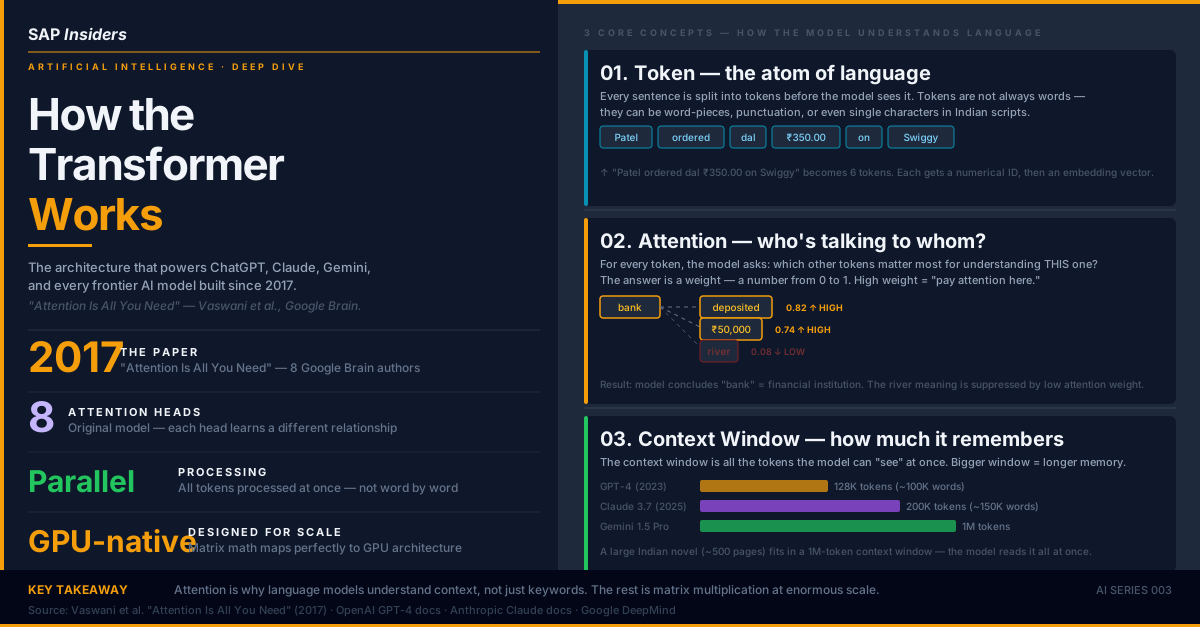
On 12 June 2017, eight researchers at Google Brain submitted a paper titled "Attention Is All You Need." The paper introduced the Transformer architecture.
The problem it solved: LSTMs processed sequences word by word, one at a time. This meant:
- You could not parallelise training across a GPU — word 3 had to wait for word 2 to finish
- Information from 50 words ago was buried under 50 rounds of compression and forgetting
- The model could not directly relate two words that were far apart in a sentence
Self-attention was the solution. For every word in a sentence, compute how much attention it should pay to every other word — simultaneously, in one pass. The word "it" in "The factory closed because it was too noisy" attends strongly to "factory," not "noise" — the model figures this out by computing attention scores between every pair of words at once.
Because this is pure matrix multiplication, it runs beautifully on GPUs. Because every word can directly look at every other word, long-range relationships are trivial. Because you can run all the computations in parallel, you can train on vastly more data.
Every major AI model since 2018 — BERT, GPT-2, GPT-3, GPT-4, Claude, Gemini, Llama — is a Transformer. This architecture is the modern internet's invisible skeleton.
Indian footnote: Two of the eight co-authors — Ashish Vaswani and Niki Parmar — are of Indian origin. The paper they wrote in 2017 is now among the most cited in computer science history.
2020–2022: From GPT-3 to ChatGPT — 100 Million Users in 60 Days
GPT-3 (May 2020): OpenAI trained a Transformer with 175 billion parameters on most of the text that had ever been written and placed on the internet. What emerged was startling. GPT-3 could write essays, translate languages, explain code, compose poetry, and answer questions it had never been explicitly trained to answer — using just a few examples in the prompt (few-shot learning). It wasn't just getting incrementally better; it was exhibiting emergent capabilities nobody had programmed.
For two years, GPT-3 was available only through a waitlisted API. Developers and researchers used it; the general public had not.
ChatGPT (30 November 2022): OpenAI took GPT-3.5 and applied Reinforcement Learning from Human Feedback (RLHF): human trainers rated model responses for helpfulness, accuracy, and harmlessness. The model was tuned to produce responses humans preferred. The result was a language model that felt conversational — that admitted uncertainty, asked clarifying questions, and engaged with vague prompts. 100 million monthly active users in 60 days. No product in history had done that.
2023–2025: The Frontier Model Race
What followed was the most intense technology competition in history:
- March 2023: GPT-4, Claude 1, and Google Bard launch within weeks of each other
- July 2023: Meta releases Llama 2 as open weights — every developer suddenly has a frontier-class model for free
- November 2023: Google DeepMind releases Gemini 1.0
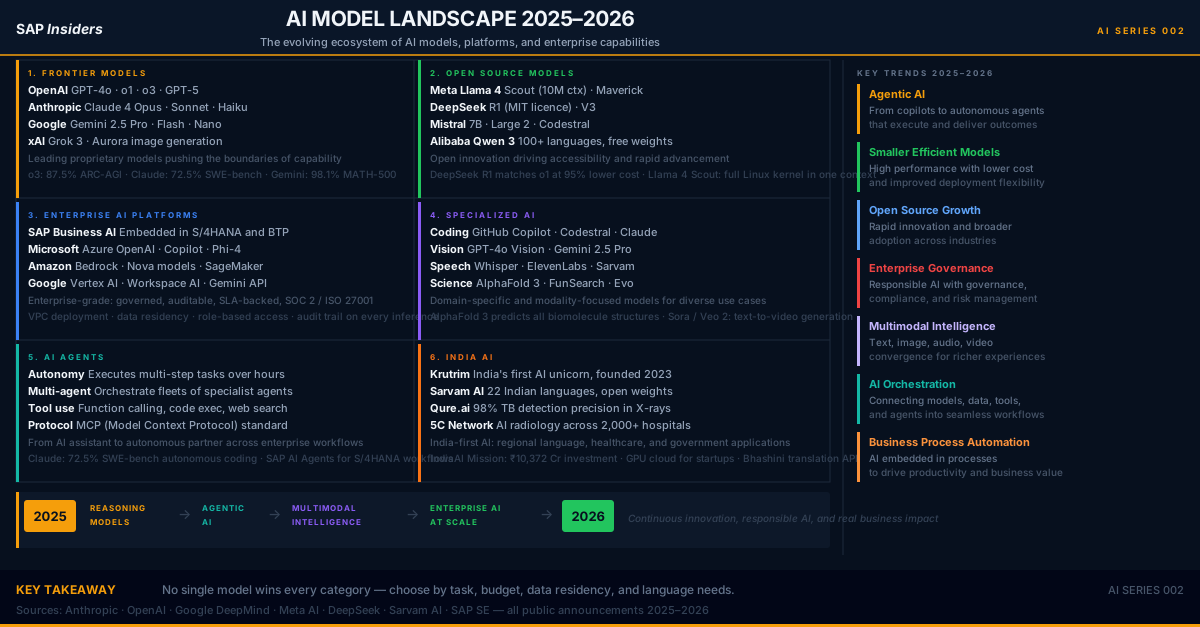
- January 2025: DeepSeek R1 from a Chinese startup matches OpenAI's best reasoning model at 5% of the cost — triggering a 17% single-day drop in NVIDIA's share price
- 2025: Gemini 1.5 Pro introduces a 1 million token context window (the ability to read an entire novel and answer questions about it); Llama 4 Scout extends that to 10 million tokens in open source
- April–May 2025: Claude 4 Opus and Sonnet, GPT-4o and o3, Gemini 2.5 Pro push capabilities to approaching human expert performance on graduate-level science benchmarks
- India 2024–2025: Krutrim (by Ola's Bhavish Aggarwal) becomes India's first AI unicorn; Sarvam AI releases multilingual models for 22 Indian languages; 5C Network deploys AI radiology across 2,000+ hospitals reading 15,000+ scans per day
The next article in this series covers every major model in full detail — every OpenAI, Anthropic, Google, Meta, DeepSeek, Mistral, and Indian AI model — with benchmarks, context windows, cost, and what each is actually best for.
Four Lessons from 70 Years
Every breakthrough solved a concrete failure. Backprop fixed training. LSTM fixed memory. The Transformer fixed parallelism and long-range context. None came from abstract ambition — they came from engineers staring at a broken thing until they found a fix.
Hype cycles are real, but so is progress. AI had two complete funding collapses before it delivered anything useful at scale. The people who gave up in 1970 and 1987 were rational given the evidence. Hinton spent 20 years working in relative obscurity after the first AI Winter. Being right too early is indistinguishable from being wrong.
Data matters as much as algorithms. AlexNet didn't just have a better algorithm — it had ImageNet. GPT-3 didn't just have a better architecture — it had most of the text ever written. The smartest algorithm on bad or insufficient data stays dumb.
Product beats model. GPT-3.5 was available for two years as an API. ChatGPT — the same model with RLHF and a simple chat interface — reached 100 million users in 60 days. The 1980s expert systems were genuinely useful in narrow domains and still got killed because nobody could maintain them. Building the right product experience around a capable model is half the problem.
Key Milestone Table
| Year | Name | What It Solved |
|---|---|---|
| 1950 | Turing Test | Defined testable AI for the first time |
| 1958 | Perceptron | Machines can learn from labelled examples |
| 1986 | Backpropagation | Training deep networks became possible |
| 1997 | LSTM | Machines gained memory across sequences |
| 2012 | AlexNet | Deep learning + GPU = modern AI begins |
| 2014 | GAN | Machines gained the ability to create |
| 2017 | Transformer | Architecture that powers everything today |
| 2022 | ChatGPT | AI reaches 100 million people in 60 days |
Sources: Turing (1950), "Computing Machinery and Intelligence"; Rumelhart, Hinton & Williams (1986), "Learning Representations by Back-Propagating Errors"; Hochreiter & Schmidhuber (1997), "Long Short-Term Memory"; Krizhevsky, Sutskever & Hinton (2012), "ImageNet Classification with Deep Convolutional Neural Networks"; Vaswani et al. (2017), "Attention Is All You Need"; Geoffrey Hinton Nobel Prize lecture (December 2024). ChatGPT user growth: OpenAI public statements. Krutrim: Bhavish Aggarwal press releases 2024.