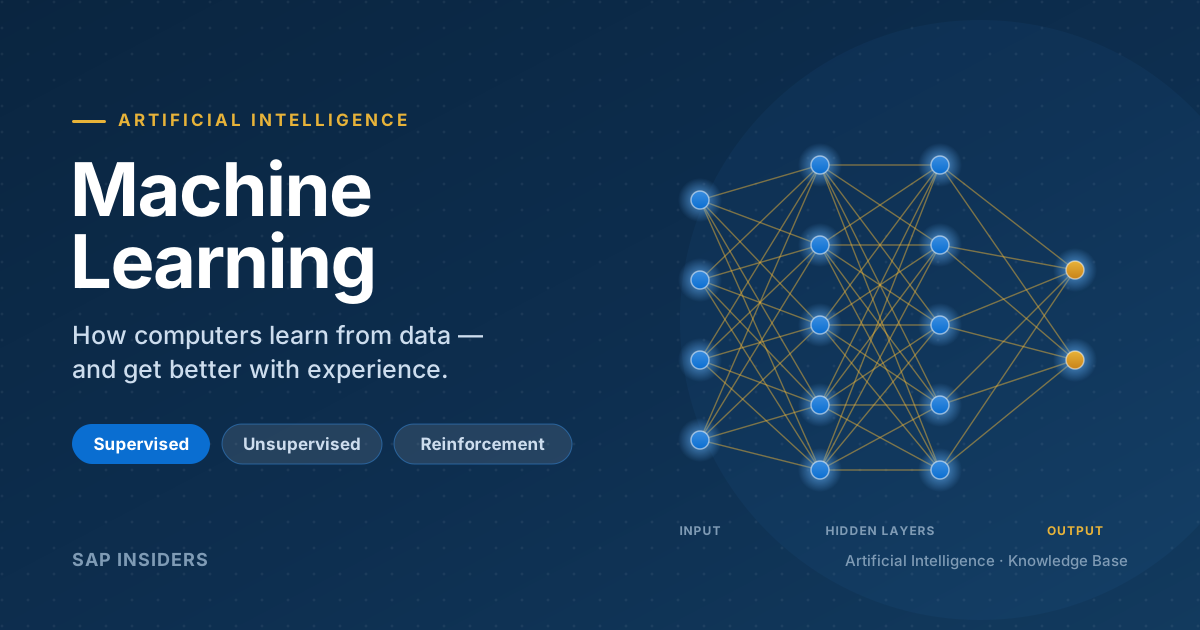
Machine learning (ML) is a type of artificial intelligence that teaches computers to learn from data and improve with experience. In plain terms: instead of following fixed, hand-written rules, the computer gets better at a task by finding patterns in examples.
Think about how you learned to tell an apple from a banana. Nobody gave you a rulebook — after seeing enough examples, you could recognise new fruit on sight. Machine learning works the same way: show a model enough data, and it learns the patterns it needs to make predictions or decisions on data it has never seen.
That single idea now powers fraud detection, demand forecasting, the recommendations you see every day, and the wave of generative and "agentic" AI reshaping how organisations work.
Machine learning vs. artificial intelligence
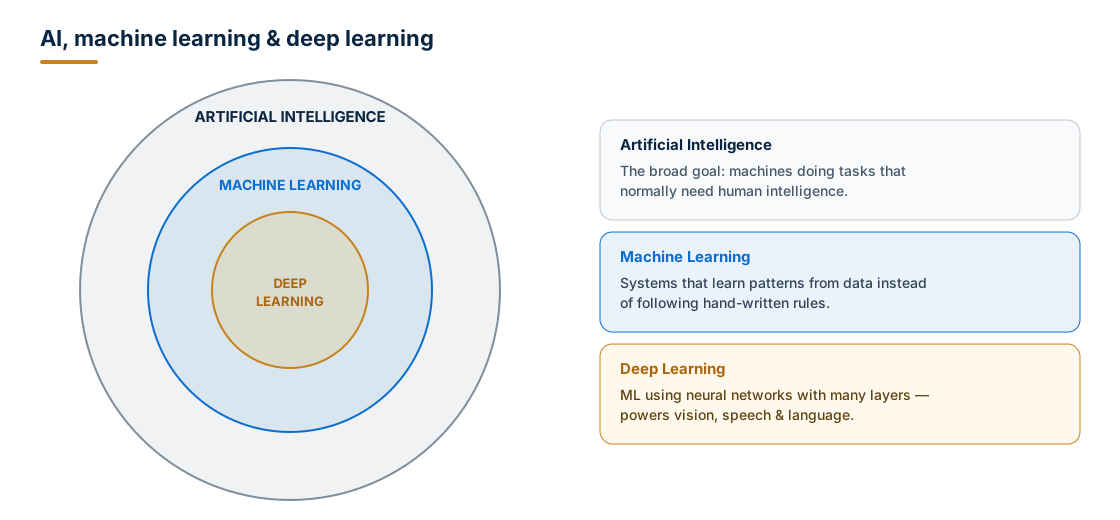
The two terms get used interchangeably, but they aren't the same thing. AI is the broad ambition — machines doing things that normally need human intelligence. Machine learning is the most successful method for getting there: rather than coding the rules by hand, you let the system discover them from data. Deep learning is a powerful sub-branch of ML that uses many-layered neural networks.
A simple way to hold it in your head:
- AI is the overall discipline of building intelligent systems.
- Machine learning is one of the methods that makes AI possible.
- Deep learning is ML scaled up with deep neural networks.
When a company says it "added AI" to a process, it's usually machine learning doing the measurable work — predicting churn, optimising inventory, or automating quality checks.
How does machine learning actually work?
However clever the algorithm, almost every ML system follows the same loop: gather data, train a model on it, make predictions, then keep improving as new data arrives.
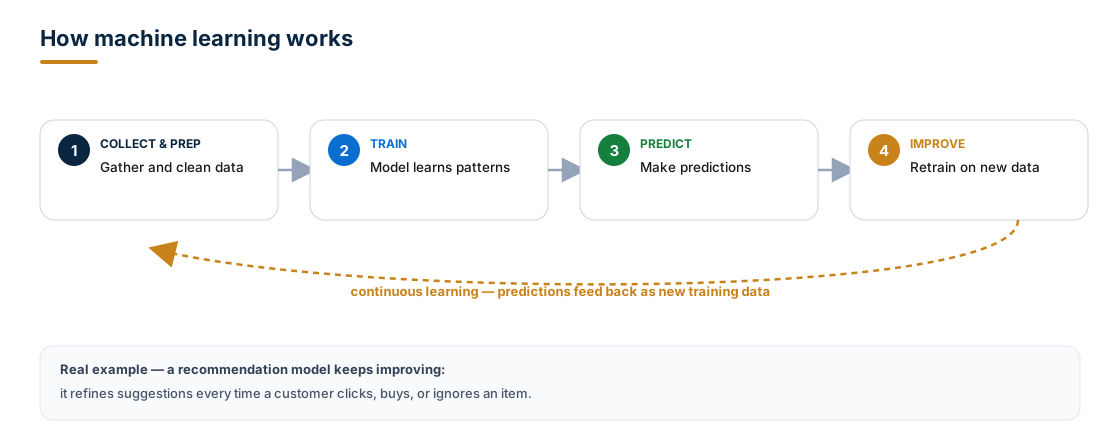
- Collect and prepare data. Everything starts with data — often a lot of it. Teams spend real effort cleaning it: removing duplicates, fixing missing values, normalising formats, and labelling examples. Garbage in, garbage out is the iron law of ML.
- Train the model. The algorithm studies the data and adjusts its internal parameters — sometimes millions of them — to minimise errors, repeating until it performs well on data it hasn't seen.
- Predict. The trained model generates predictions, classifications, or recommendations on new inputs.
- Improve. Predictions are monitored and fresh data is fed back to retrain the model. This feedback loop is what lets ML systems stay accurate as the world changes — a recommendation engine sharpens as you click, a fraud model adapts as new scam patterns appear.
The three types of machine learning
Most algorithms fall into three families, each suited to a different kind of problem and data.
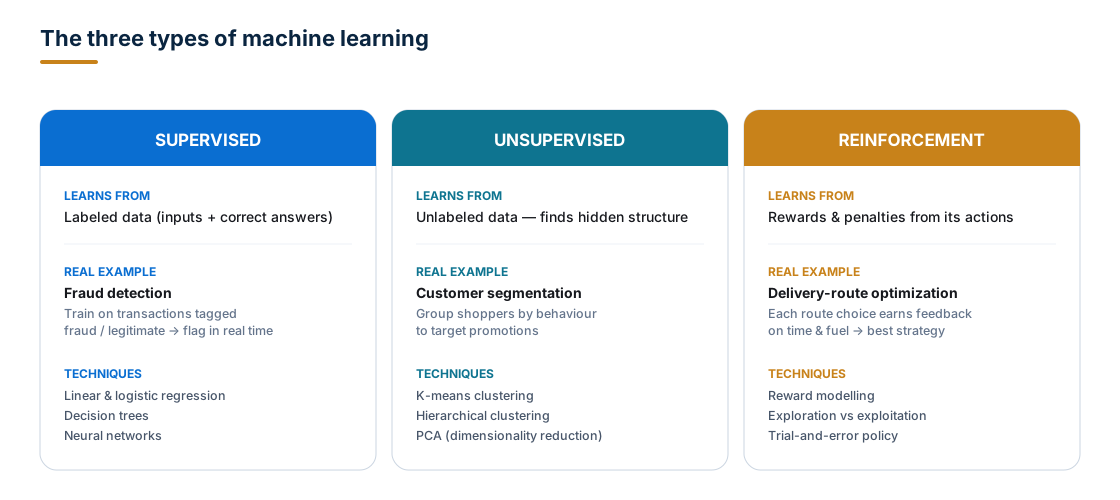
- Supervised learning trains on labelled data — inputs and the correct answers. It's the workhorse of business ML. A bank trains a model on thousands of transactions tagged "fraud" or "legitimate"; it learns the tell-tale patterns (amount, location, time, device) and then flags suspicious activity in real time. Techniques: linear/logistic regression, decision trees, support vector machines, neural networks.
- Unsupervised learning works on unlabelled data and finds structure on its own. A retailer can segment customers by purchasing behaviour without telling the model what the groups are. Techniques: clustering (K-means, hierarchical) and dimensionality reduction (PCA).
- Reinforcement learning learns by trial and error, earning rewards or penalties from its environment. A logistics model optimising delivery routes gets feedback on time and fuel for each choice, and over many iterations discovers the best strategy. It balances exploration (trying new actions) with exploitation (using what works).
Inside a neural network
Neural networks are algorithms loosely inspired by the brain: layers of "neurons" that each take inputs, apply a function, and pass results on. Through training, the network learns which connections matter most.
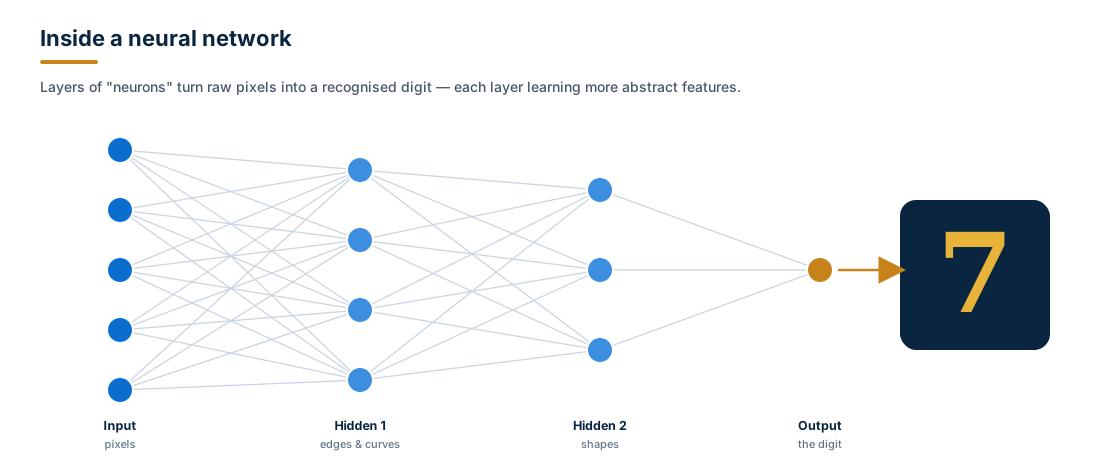
Classic example: recognising handwritten digits. Early layers pick out simple features like lines and curves; deeper layers combine them into shapes and, finally, a digit. Deep learning stacks many such layers, which is what makes today's voice assistants, image tagging, language translation, and self-driving perception possible. The trade-off: deep models need lots of compute and well-prepared data, so many organisations blend traditional ML with deep learning to balance accuracy and cost.
From prediction to creation: generative and agentic AI
Machine learning is also the engine behind the newest forms of AI:
- Generative AI doesn't just analyse patterns — it produces new content (text, images, code, music) by learning from huge datasets. It lets marketers draft copy in seconds, designers visualise concepts faster, and engineers accelerate coding.
- Agentic AI goes a step further: systems that act with autonomy — combining ML's perception with reasoning, memory, and multi-step planning. ML is what lets these agents adapt to new information instead of being stuck on fixed rules.
Machine learning all around us
ML is already woven into daily life and core business operations — often invisibly.
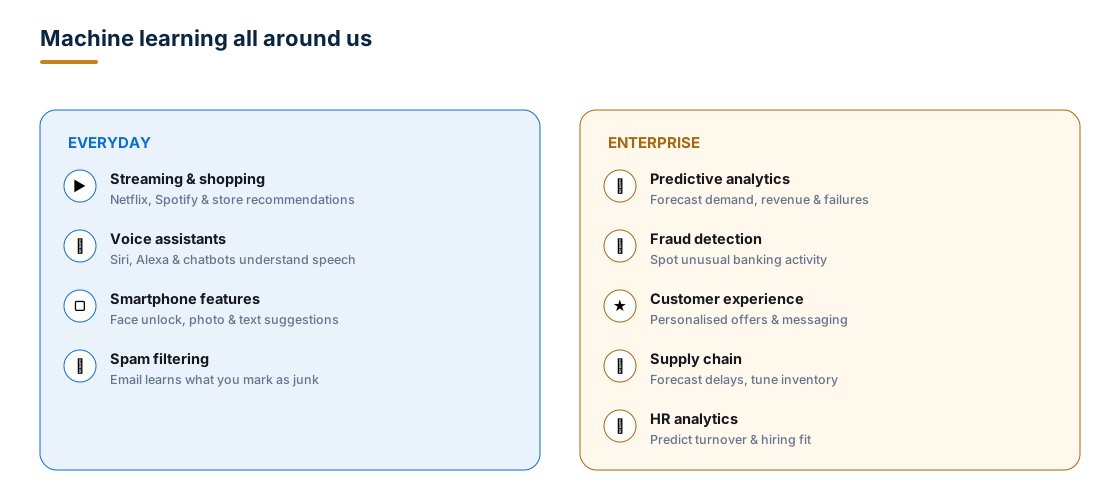
Everyday: streaming and shopping recommendations, voice assistants and chatbots, smartphone face unlock and predictive text, and email spam filtering that learns from what you mark as junk.
Enterprise: predictive analytics (demand, revenue, equipment failure), fraud detection, customer-experience personalisation, supply-chain forecasting, and HR analytics for hiring and retention. In business, ML isn't about replacing people — it's about amplifying expertise: automating the repetitive so teams focus on higher-value decisions.
Why it matters: benefits and challenges
| Benefits | Challenges to manage |
|---|---|
| Automation & efficiency — speeds up complex decisions, cuts cost | Data quality & governance — models inherit the flaws of their data |
| Personalisation — tailors experiences in real time | Transparency — deep models can be hard-to-explain "black boxes" |
| Predictive insight — forecasts outcomes from history | Ethics & bias — can amplify human or societal bias if unmanaged |
| Continuous improvement — gets better with new data | Compute cost — training large models is resource-intensive |
| Innovation — enables entirely new products and services | Integration — embedding ML into systems takes expertise |
The takeaway: ML's real value isn't just what it automates, but how it augments human judgement — provided it's built on good data and responsible, transparent practices.
Frequently asked questions
What is machine learning in simple terms? A type of AI where systems learn patterns from data and improve with experience, without being explicitly programmed.
What are the types of machine learning? Three main ones: supervised (labelled data → predictions), unsupervised (find patterns in unlabelled data), and reinforcement (learn by reward and penalty).
Is machine learning all coding? It involves programming — Python, R, libraries like TensorFlow, PyTorch and Scikit-learn — but many enterprise tools now embed ML so users get the insights without writing code.
ML vs. data science? Data science is the broader field of extracting insight from data; machine learning is the subset focused on algorithms that learn to predict or decide.
Key takeaways
- Machine learning is AI that learns from data instead of following hand-coded rules.
- It works as a loop: data → training → prediction → continuous improvement.
- The three types — supervised, unsupervised, reinforcement — cover prediction, discovery, and decision-making.
- Neural networks and deep learning unlock vision, speech, and language; they also power generative and agentic AI.
- The winners aren't those who automate the most, but those who pair ML with good data and responsible practices to amplify human judgement.