Most planning disputes are vocabulary disputes. A demand planner saying "forecast" can mean the baseline, the statistical, or the consensus. A buyer saying "lead time" might mean planned delivery time, decoupled lead time, or the supplier's actual quoted time. An MRP controller and an S&OP lead can spend ninety minutes on the same agenda item and disagree about whether they're even talking about the same number.
This is the planner's working vocabulary — fifty terms that come up in every S/4HANA project, every IBP rollout, every monthly S&OP meeting. Each one has a one-line definition, a short concrete example, and where it shows up in SAP if applicable.
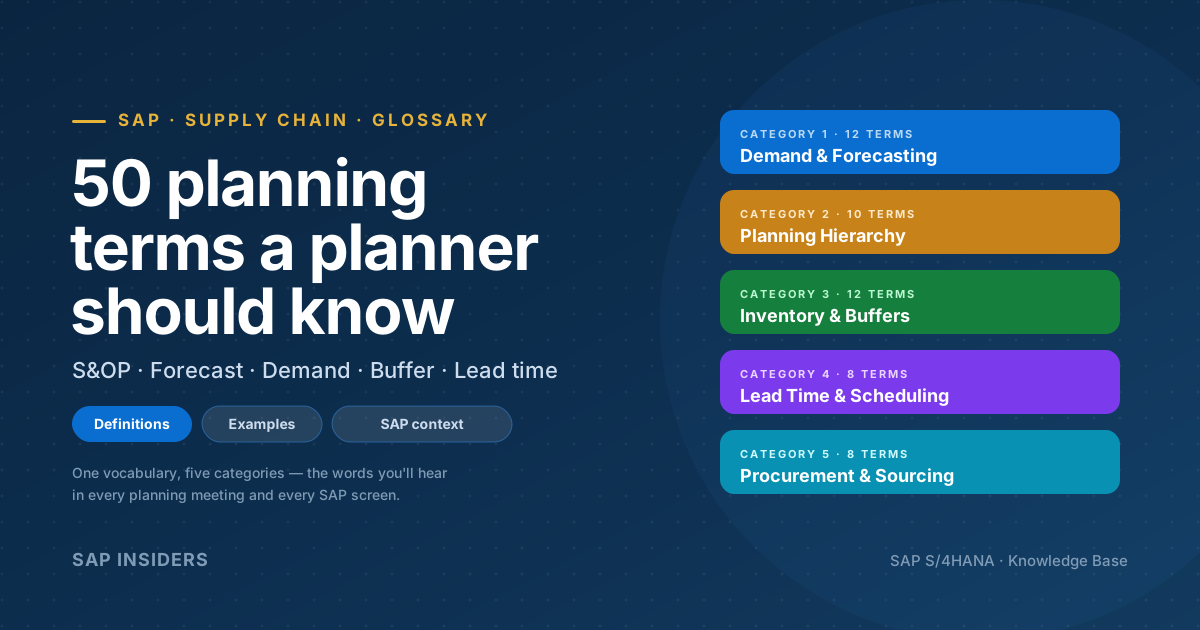
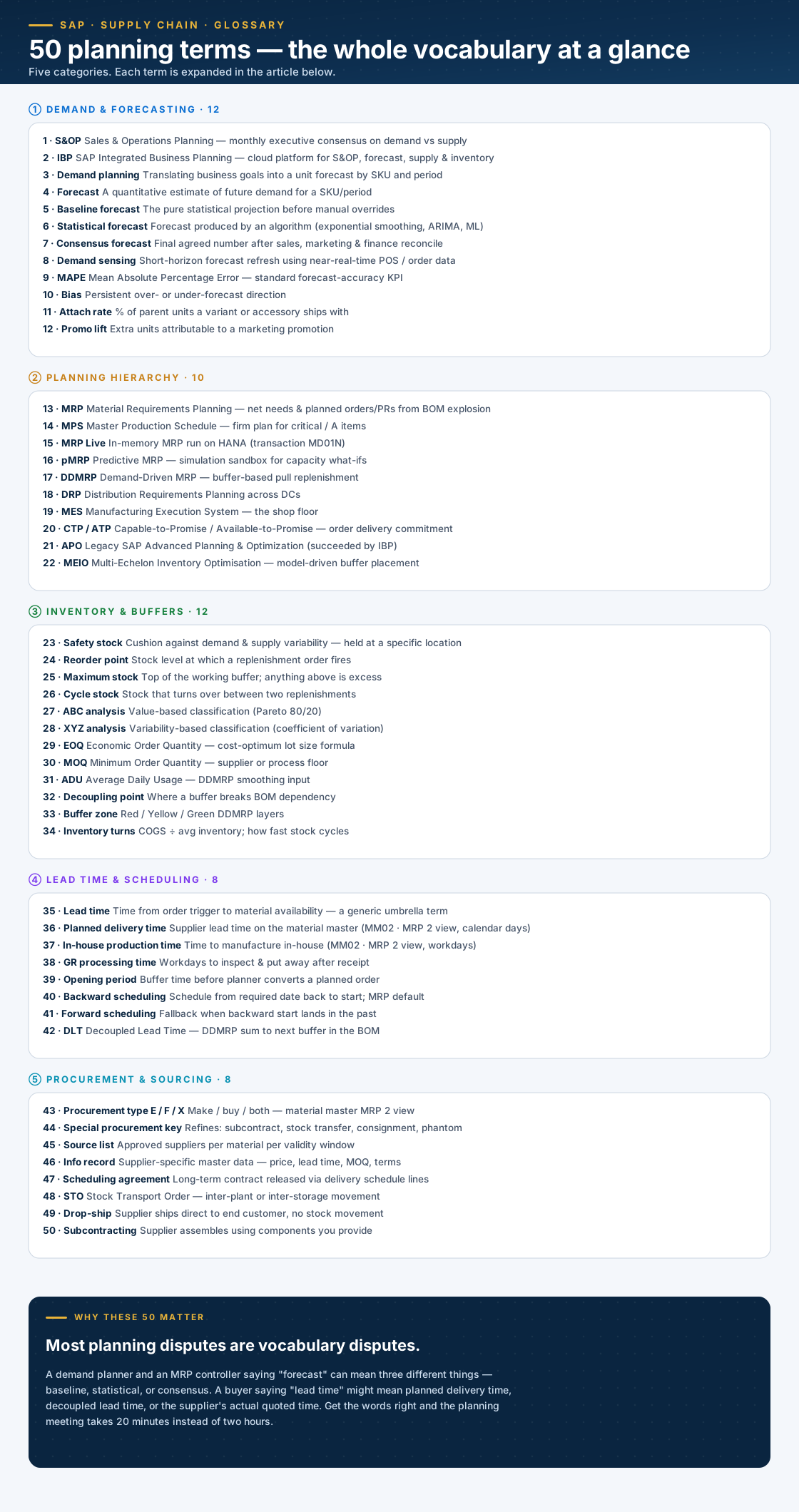
Here's the whole map first — the article expands each section below.
① Demand & Forecasting
The numbers that come into the planning process — what we expect customers to want, when, and with what confidence.
1 · S&OP (Sales & Operations Planning). A monthly executive process that aligns the demand plan, the supply plan, and the financial plan at product-family level. Owned by general management, not just supply chain. Example: a quarterly review concludes that the consensus forecast for the next quarter is 12% above current capacity → S&OP commits to a fourth shift on Line B. SAP: SAP Integrated Business Planning (IBP) for S&OP module, or the legacy ECC + APO setup.
2 · IBP (Integrated Business Planning). SAP's cloud planning platform — successor to APO. Modules for Demand, Supply, Inventory, S&OP, Control Tower, Demand-Driven Replenishment. Example: a global CPG runs its monthly statistical forecast in IBP Demand, then publishes the consensus to S/4HANA as PIRs.
3 · Demand planning. The process of translating business goals (sales targets, market share, promotions) into a unit forecast by SKU and period. Example: demand planning combines the statistical baseline, a known holiday promotion lift, and a new-product introduction ramp into a single number for July.
4 · Forecast. A quantitative estimate of future demand for a SKU and period. Always belongs to a level (SKU vs family) and a bucket (week vs month). Example: the forecast for SKU-ABC123, week 28, plant 1000 is 240 units.
5 · Baseline forecast. The pure statistical projection before any manual overrides or business inputs. Example: the baseline says 180 units for week 28; the demand planner overrides to 240 because of a known promotion.
6 · Statistical forecast. Forecast produced by an algorithm — exponential smoothing, Holt-Winters, ARIMA, or modern ML/gradient-boosting. Each method handles trend, seasonality, and outliers differently. Example: IBP Demand tries six different methods on the history and picks the one with the lowest MAPE.
7 · Consensus forecast. The final agreed number after sales, marketing, finance, and supply chain reconcile their views. This is what drives the supply plan. Example: sales says 280, finance says 200, statistical says 220 → consensus lands at 240.
8 · Demand sensing. Short-horizon forecast refresh (typically next 1–4 weeks) using near-real-time signals like point-of-sale data, distributor sell-out, or open orders. Example: IBP Demand Sensing detects that two large customers have placed orders 30% above plan in week 27 → adjusts the week-28 forecast up by 5% automatically.
9 · MAPE (Mean Absolute Percentage Error). The industry-standard forecast-accuracy KPI. MAPE = mean( |actual − forecast| / actual ). Lower is better. Example: a SKU with MAPE of 18% means the forecast is, on average, off by 18% in either direction.
10 · Bias. Persistent over-forecast (positive bias) or under-forecast (negative bias) direction over a period. Unlike MAPE, the sign matters. Example: MAPE of 15% can hide a positive bias of +12% — the forecast is systematically high; consensus needs to be lowered.
11 · Attach rate. The percentage of parent units that ship with a particular variant or accessory. Example: 65% of laptops sold attach a docking station → forecasting docking stations means forecasting laptops × 65%.
12 · Promo lift. The extra units attributable to a marketing promotion, on top of baseline demand. Example: baseline says 1,000 units/week; with the planned promo the demand planner adds a 30% lift = 1,300 units in promo weeks.
② Planning hierarchy
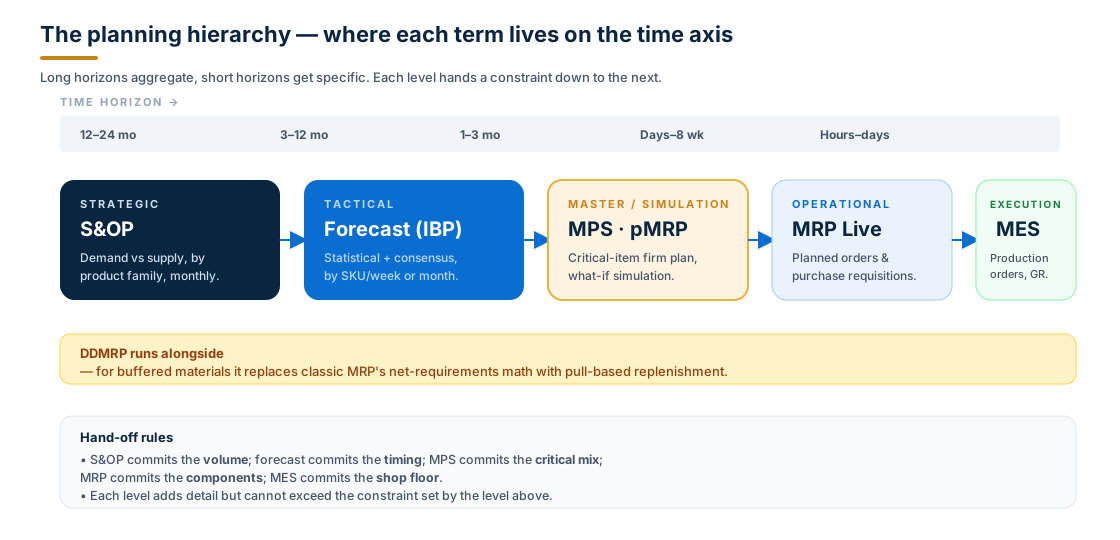
These are levels of planning, each with its own horizon, granularity, and SAP home. Knowing which level you're operating at prevents the most common planning conversation: two people working at different altitudes.
13 · MRP (Material Requirements Planning). The classical algorithm that turns demand into net material requirements, then into planned orders and purchase requisitions. Operates on dependent demand via BOM explosion. Example: a sales order for 100 pumps drives MRP to plan 100 motors, 100 impellers, 200 bearings, and so on.
14 · MPS (Master Production Schedule). A constrained, manually validated plan for the most critical materials — typically finished goods or high-value sub-assemblies. MPS-managed items get planned first; MRP picks up dependent demand from there. Example: the top 20 SKUs by revenue are MPS-managed in S/4HANA via MRP type M0 or M1.
15 · MRP Live. S/4HANA's in-memory MRP run on HANA. Transaction code MD01N. Runs the entire MRP calculation as a single in-memory job. Example: a planning run that took 6 hours on ECC's MD01 typically finishes in 20-30 minutes on MD01N.
16 · pMRP (Predictive MRP). A simulation sandbox built on the MRP engine. Runs against a copy of master data; writes nothing back unless released. Example: "if we accept this fleet order for 200 espresso machines in Q3, does our converter line break?" — answered in pMRP without committing the live plan.
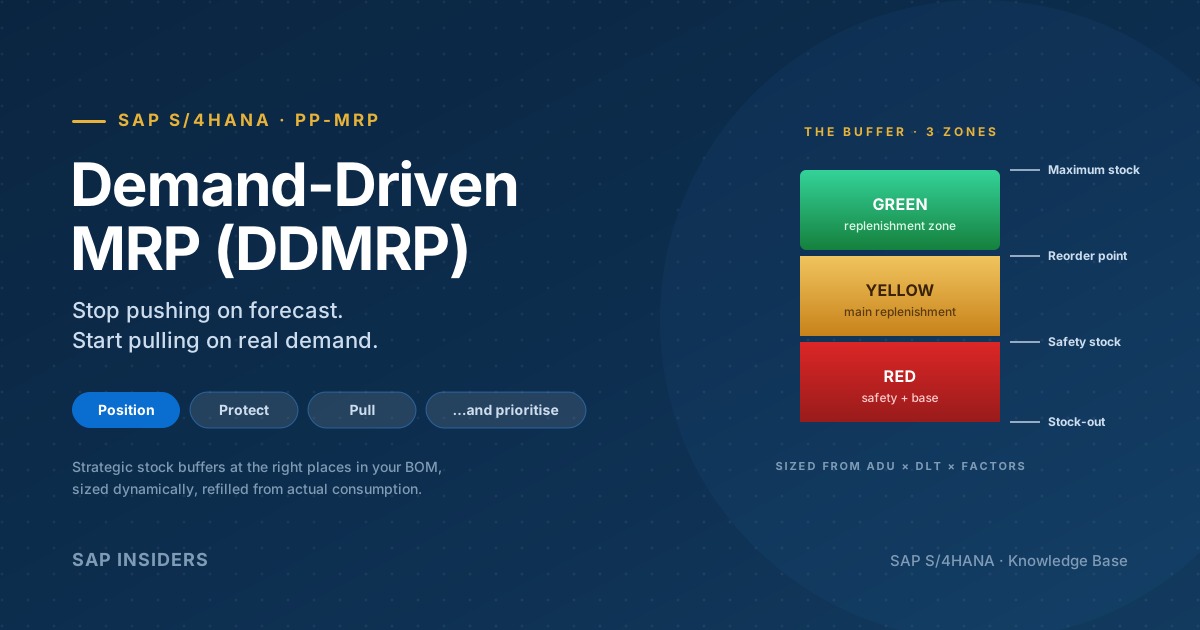
17 · DDMRP (Demand-Driven MRP). A pull-based replenishment method that places strategic stock buffers at decoupling points and replenishes from actual consumption. Example: the impeller assembly buffer carries enough stock to cover 14 days of average daily usage plus variability cushion — refilled from goods issues, not forecast.
18 · DRP (Distribution Requirements Planning). Planning the flow of finished goods across distribution centres — when each DC needs to be replenished from the source plant. Example: DC-East needs 5,000 units by week 30; with planned delivery time of 6 days, the source plant must dispatch by week 29.
19 · MES (Manufacturing Execution System). Shop-floor execution — converts production orders into actual goods movements, OEE tracking, machine signals. Example: SAP Digital Manufacturing (formerly ME / MII) sits between S/4HANA orders and the equipment on the floor.
20 · CTP / ATP (Capable-to-Promise / Available-to-Promise). How the system answers "when can we ship this?" for a sales order. ATP checks stock + planned receipts; CTP also checks capacity and lead times. Example: a customer asks for 500 units by Friday; ATP confirms 300 available, CTP confirms the other 200 buildable on the line that day.
21 · APO (Advanced Planning & Optimization). The legacy SAP advanced planning suite — DP (Demand Planning), SNP (Supply Network Planning), PP/DS (Production Planning & Detailed Scheduling). Largely succeeded by IBP, except PP/DS which moved into embedded S/4HANA. Example: a brownfield SAP customer is migrating its APO DP to IBP Demand and its PP/DS to embedded PP/DS in S/4HANA.
22 · MEIO (Multi-Echelon Inventory Optimisation). Mathematical optimisation of safety stock levels across a network of warehouses, plants, and DCs. Answers "where should the buffer live and how big should it be?" Example: IBP Inventory Optimisation runs MEIO to reduce total network safety stock by 18% while holding service level constant.
③ Inventory & buffers
The terminology of stock — what to hold, how much, where, and why.
23 · Safety stock. A cushion against demand and supply variability. Held at a specific location. Example: the safety stock for finished pumps at DC-North is 50 units — that's the minimum on hand before replenishment is overdue.
24 · Reorder point. The stock level at which a replenishment order should fire. Calculated as lead-time demand + safety stock. Example: with ADU = 10 and supplier lead time = 14 days, the reorder point is 140 + 50 safety = 190 units.
25 · Maximum stock. The top of the working buffer — anything above this is considered excess. Example: max stock = 350 → when receipts push above, the planner reviews for over-supply.
26 · Cycle stock. The portion of inventory that turns over between two replenishments. Distinct from safety stock (which doesn't normally turn over). Example: if you replenish every 4 weeks and average usage is 100/week, cycle stock is 400.
27 · ABC analysis. Classification by value (Pareto's 80/20 applied to goods-issue value). A items = top ~20% by value but ~80% of total consumption value. Example: a plant with 10,000 SKUs finds 800 of them drive 80% of the inventory value — those 800 are A items.
28 · XYZ analysis. Classification by variability of demand (coefficient of variation). X = steady, Z = highly variable. Example: daily toothpaste at a retailer is X; specialty seasonal candles are Z.
29 · EOQ (Economic Order Quantity). The lot size that minimises total cost (ordering + holding) for a given demand rate. Classical formula: EOQ = sqrt(2 × D × S / H). Example: annual demand 10,000, order cost $50, holding cost $2/unit → EOQ = 707 units per order.
30 · MOQ (Minimum Order Quantity). The smallest quantity a supplier will accept per order, or the minimum a process step will produce per setup. Often dwarfs EOQ. Example: a contract supplier's MOQ is 5,000 even if you only need 500 — your effective order is the MOQ.
31 · ADU (Average Daily Usage). The smoothed daily consumption rate, computed over a rolling window (the averaging interval). Central to DDMRP. Example: with averaging interval of 90 days and 8,100 total goods issues, ADU = 90/day.
32 · Decoupling point. A strategic location in the supply chain where a buffer breaks BOM dependency. Upstream replenishes the buffer, not the customer order. Example: a finished-pump DC is a decoupling point — customers see 48-hour delivery while production has 6 weeks to replenish the buffer.
33 · Buffer zone. DDMRP's three colour-coded buffer layers — Red, Yellow, Green — each calculated from ADU, DLT, and two factors. Example: Red = 525, Yellow = 700, Green = 350 → buffer max = 1,575; reorder point at 1,225.
34 · Inventory turns. A KPI measuring how fast stock cycles. turns = annual COGS ÷ average inventory value. Example: COGS of $50M and average inventory $5M → 10 turns; same COGS at $10M inventory → only 5 turns.
④ Lead time & scheduling
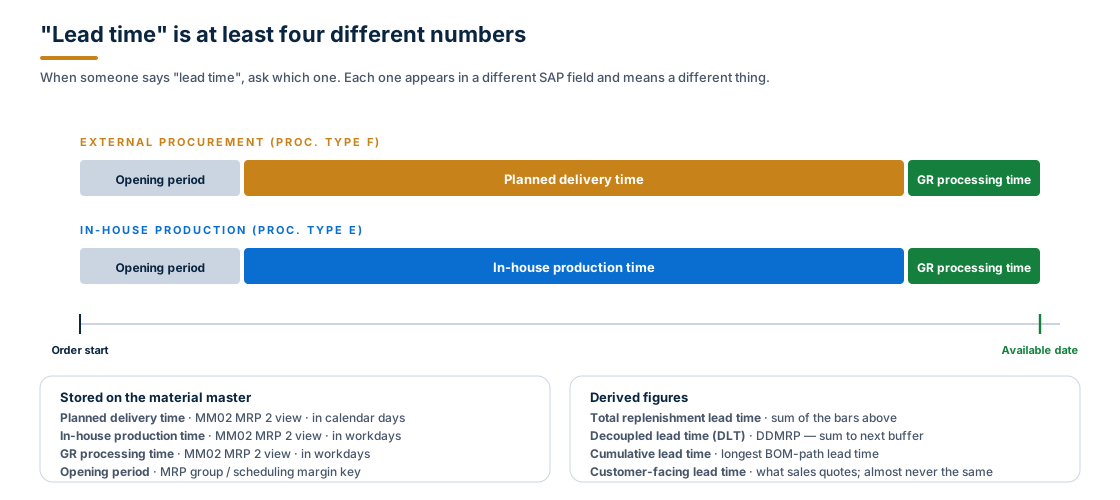
When someone says "lead time", ask which one. There are at least four.
35 · Lead time. The total time from triggering an order to the material being available — a generic umbrella term that needs specifying. Example: "the lead time on this part is 6 weeks" is incomplete — supplier lead time? cumulative lead time? customer-facing lead time?
36 · Planned delivery time. Supplier lead time stored on the material master (MM02, MRP 2 view), in calendar days, used by MRP for externally-procured parts. Example: supplier quotes 21 days from order; the material master Planned delivery time field reads 21.
37 · In-house production time. Time to manufacture in-house, in workdays, on the MRP 2 view. Example: assembling a pump takes 5 workdays; weekends are skipped when MRP schedules.
38 · GR processing time. Workdays needed to inspect and put away the goods after receipt — separately stored on MRP 2. Example: a finished pump needs 2 days of QA before becoming available stock → GR processing time = 2.
39 · Opening period. Buffer time between MRP creating a planned order and the planner converting it. Held in the scheduling margin key. Example: opening period of 3 days means planned orders are dated 3 days before the actual production start.
40 · Backward scheduling. MRP's default — start from the required date and work backwards through GR processing, production time, and opening period to find the order start date. Example: required by Day 30, GR 2 days, production 5 days, opening 3 days → planned order start Day 20.
41 · Forward scheduling. Fallback when backward scheduling lands the start date in the past. Starts from today and adds lead times, producing a late but realistic availability date. Example: customer asked for Day 5, today is Day 4, but production needs 5 days → forward scheduling commits to Day 9.
42 · DLT (Decoupled Lead Time). DDMRP-specific — the sum of the longest lead times of non-buffered components up the BOM to the next buffer or to the top-level. Example: with a finished-pump buffer in place, DLT for that buffer is just the final-assembly time (5 workdays) — components are buffered, so they're not in the path.
⑤ Procurement & sourcing
How materials actually enter the plant — make it, buy it, or shift it from elsewhere.
43 · Procurement type (E / F / X). The make-or-buy switch on the material master MRP 2 view. E = in-house production, F = external procurement, X = both allowed. Example: a finished-goods FERT material is usually E; a raw material ROH is usually F; a flexible component may be X.
44 · Special procurement key. Refines the procurement type with sourcing variations — stock transfer (40), subcontracting (30), consignment (10), phantom assembly (50). Example: a part procured from a sister plant uses procurement type F + special procurement key 40 → MRP creates a stock-transport requisition.
45 · Source list. A list of approved suppliers for a material at a plant, with validity windows and quotas. Example: source list shows supplier A from Jan-Jun (50% quota), supplier B from Jan-Dec (50% quota).
46 · Info record. Supplier-specific master data linking a material to a supplier — price, lead time, MOQ, scale prices, terms. Example: the info record for steel bar from supplier ACME holds Net price: 4.20 EUR/kg, Planned delivery time: 14 days, MOQ: 1,000 kg.
47 · Scheduling agreement. A long-term contractual commitment with a supplier, released via delivery schedule lines as the demand date approaches. Example: an annual scheduling agreement for 100,000 units; each week MRP releases a schedule line for the next 4 weeks of demand.
48 · STO (Stock Transport Order). Inter-plant or inter-storage-location stock movement order. Triggered by MRP with special procurement key 40. Example: DC-North runs short → MRP creates an STO to pull 200 units from DC-South.
49 · Drop-ship. The supplier ships direct to the end customer; no stock ever enters your warehouse. Example: an online retailer takes a customer order, sends the PO direct to the supplier, who ships to the customer — the retailer never touches the goods.
50 · Subcontracting. A supplier assembles or processes goods using components you provide to them. Your stock travels to the subcontractor and comes back as a finished part. Example: you ship circuit boards to an assembly subcontractor, who returns finished control units. Special procurement key 30.
Why this vocabulary matters
The same word means different things to different people in the same meeting. Three quick illustrations:
- "Forecast" — the demand planner means the consensus; the sales VP means his target; the finance director means the budget. None of them are wrong; all of them are talking past each other.
- "Lead time" — the buyer thinks of supplier quoted lead time; the MRP controller thinks of planned delivery time on the material master; the customer-service rep thinks of what sales promised. Different fields, different numbers, sometimes triple-counted.
- "Safety stock" — the inventory controller means the static MM02 number; the DDMRP planner means the Red zone; the executive means "the buffer we never want to break into." None match exactly.
A planning meeting that opens with "when we say X, do we mean A, B, or C?" finishes in twenty minutes. A meeting that doesn't tends to last two hours and decide nothing.
Key takeaways
- S&OP, demand planning, and forecast are three layers of the same demand process — strategic, tactical, and quantitative.
- The planning hierarchy runs S&OP → IBP forecast → MPS/pMRP → MRP Live → MES. Each level commits a constraint to the level below.
- DDMRP is an extension to MRP, not a replacement — used for buffered, decoupling-point materials.
- "Lead time" is a family of distinct numbers — planned delivery time, in-house production time, GR processing time, opening period, DLT — each stored in its own SAP field.
- Procurement type + special procurement key decides how MRP physically sources a material — make-or-buy is just the first level.
- The most valuable thing a planning team can agree on is a shared vocabulary. Forty-five minutes spent aligning on what words mean saves weeks of misunderstood plans downstream.
Bookmark this page. Send it to a new joiner. Drop it into a project glossary. Half the planning battle is just calling the same thing by the same name.