Introduction to BOM in SAP
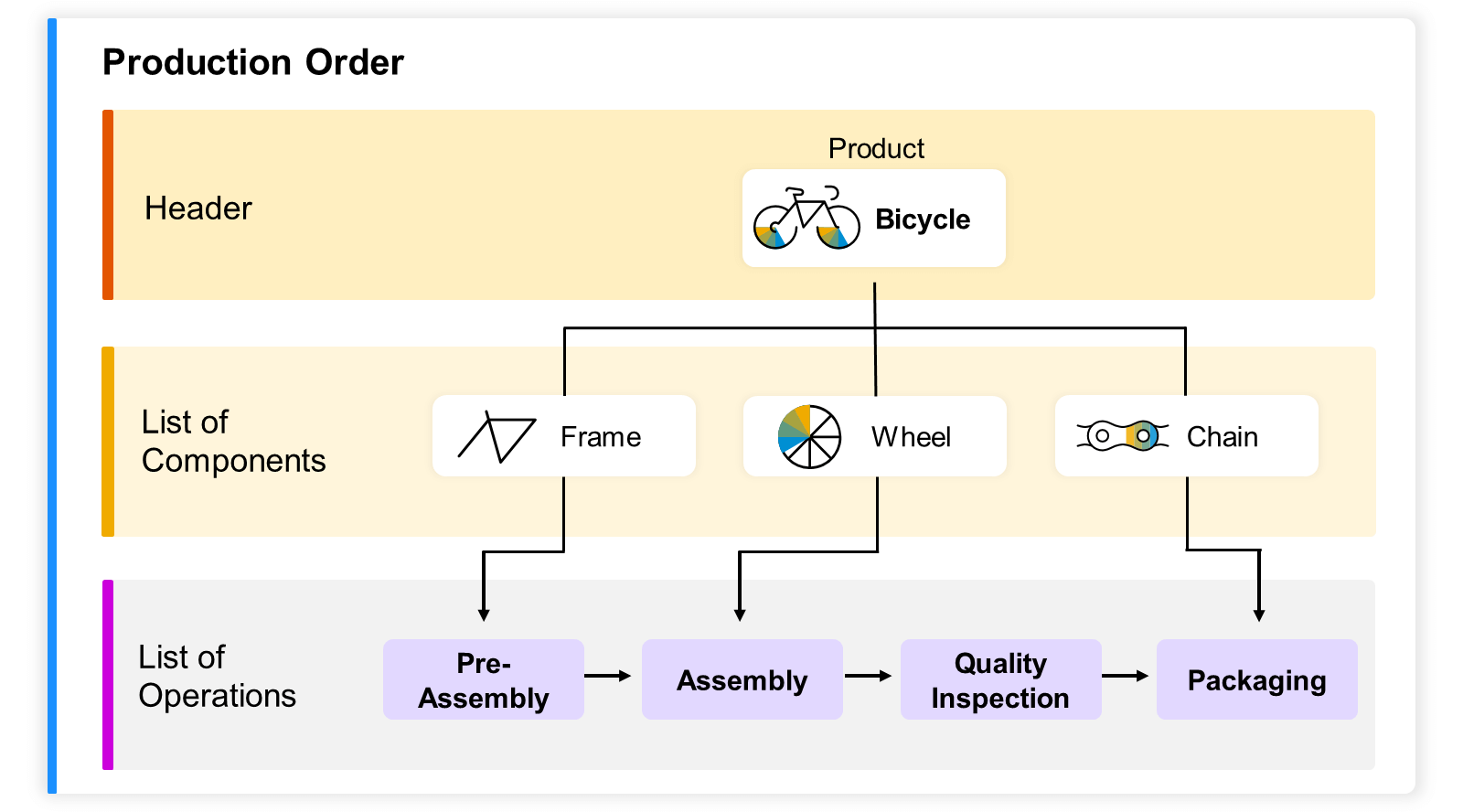
A Bill of Materials (BOM) in SAP defines the structure of a product, including its components, sub-components, and raw materials. It is essential for manufacturing, costing, maintenance, sales, and inventory management.
In SAP, BOM behavior is controlled by two important parameters:
- BOM Application → Defines which SAP module or function will use the BOM.
- BOM Usage → Determines how the BOM is structured and applied in different business processes.
These two settings ensure the BOM is used correctly in various business scenarios.
BOM Application in SAP
What is BOM Application?
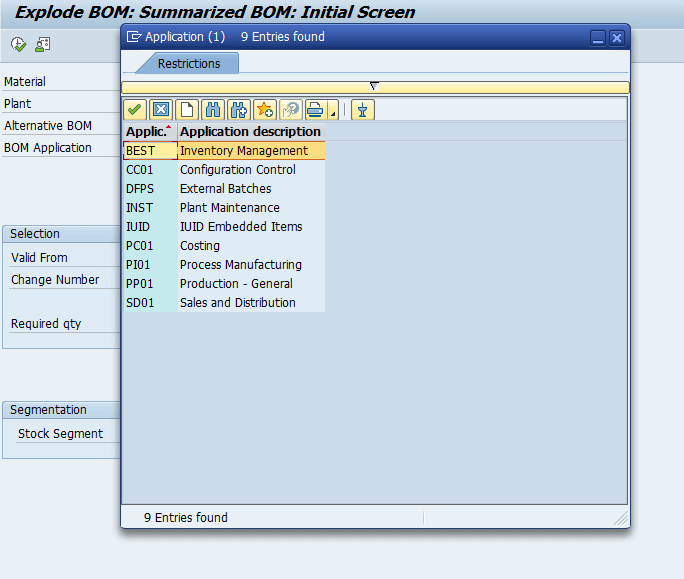
BOM Application assigns the BOM to a specific SAP module like Inventory Management (MM), Production (PP), Sales (SD), Costing (CO), or Maintenance (PM). It helps determine where and how a BOM will be used in business processes.
List of BOM Application Types & Examples
| Application Code | Application Description | Usage Scenario |
|---|---|---|
| BEST | Inventory Management | Used for goods movements, stock updates, and warehouse processes. |
| CC01 | Configuration Control | Used for variant configuration, ensuring correct BOM selection for customizable products. |
| DFPS | External Batches | Used in defense and aerospace for tracking externally procured batches. |
| INST | Plant Maintenance | Used for maintenance BOMs to manage spare parts and servicing. |
| IUID | IUID Embedded Items | Used for tracking uniquely identified items (U.S. defense compliance). |
| PC01 | Costing | Used for cost estimation and cost accounting. |
| P101 | Process Manufacturing | Used in process industries like pharmaceuticals, chemicals, and food production. |
| PP01 | Production - General | Used in discrete manufacturing for production orders. |
| SD01 | Sales and Distribution | Used for sales BOMs, order BOMs, and variant pricing. |
BOM Usage in SAP
What is BOM Usage?
BOM Usage defines how the BOM is structured and in which business process it is applied, such as production, costing, sales, or maintenance.
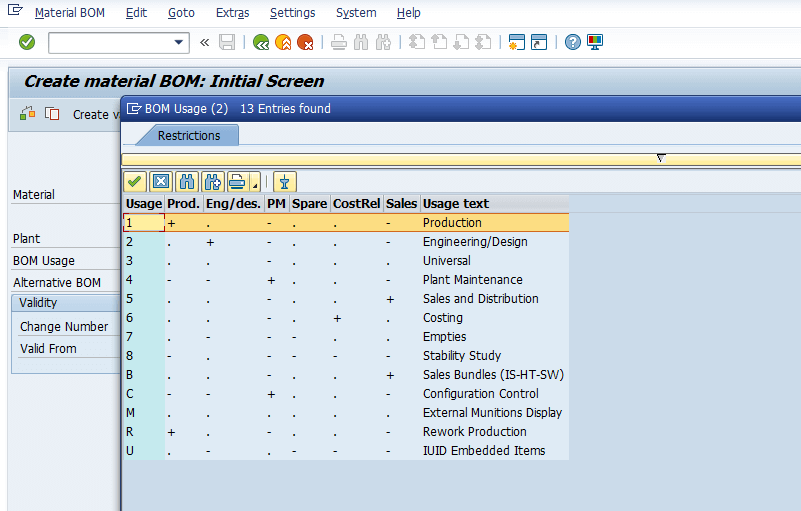
List of BOM Usage Types & Examples
| Usage Code | Usage Text | Definition | Example Use Case |
|---|---|---|---|
| 1 | Production | Used for manufacturing processes, MRP, and production orders. | A car manufacturer assembles vehicles using a production BOM. |
| 2 | Engineering/Design | Used in product development and R&D. | A mobile phone company defines a prototype BOM for new models. |
| 3 | Universal | A flexible BOM used across multiple areas like production, costing, or maintenance. | A computer manufacturer has a single BOM valid for both production and sales. |
| 4 | Plant Maintenance | Used for spare parts and equipment servicing. | A power plant maintains a BOM for a turbine including replacement parts. |
| 5 | Sales and Distribution | Used in sales processes for customer-specific BOMs. | A furniture company sells customized sofas where customers select fabric and size. |
| 6 | Costing | Used in cost calculation and product costing. | A pharmaceutical company calculates drug production costs based on BOM components. |
| 7 | Empties | Used for returnable packaging materials. | A beverage company tracks returnable glass bottles in supply chain. |
| 8 | Stability Study | Used in product stability testing. | A cosmetics company tests the stability of skincare products. |
| 9 | Sales Bundles (IS-HT-SW) | Used for bundled product sales in the high-tech industry. | A software company sells a package including a laptop, antivirus, and warranty. |
| C | Configuration Control | Used in variant configuration for customizable products. | A car company lets customers configure engine type and interior features. |
| E | External Munitions Display | Used in defense industries for tracking munitions. | A military supplier maintains BOMs for different missile configurations. |
| R | Rework Production | Used for reworking defective products. | A semiconductor company has a BOM for repairing faulty microchips. |
| U | IUID Embedded Items | Used for tracking uniquely identified items in aerospace and defense. | A defense contractor tracks aircraft components with unique serial numbers. |
Relationship Between BOM Application & BOM Usage
Key Differences:
| Criteria | BOM Application | BOM Usage |
|---|---|---|
| What it Controls? | Defines the SAP module or process using the BOM. | Defines how the BOM is structured and applied. |
| Scope | Module-specific (PP, SD, MM, CO, etc.). | Business process-specific (Production, Sales, Costing, etc.). |
| Example | PP01 (Production BOM for manufacturing). | Usage 1 (BOM used in production orders). |
Example of How Both Work Together
A pharmaceutical company manufacturing tablets needs:
- Production BOM (Application: PP01, Usage: 1) → Used for manufacturing.
- Costing BOM (Application: PC01, Usage: 6) → Used to estimate production costs.
- Sales BOM (Application: SD01, Usage: 5) → Used to define customer packaging options.
- Stability Study BOM (Application: INST, Usage: 8) → Used in regulatory testing.
This ensures that the BOM serves different business needs without confusion.
End-to-End SAP Process Flow: BOM Application & Usage
Step 1: Create a BOM (Transaction: CS01)
- Define the material components, quantity, and structure.
- Assign BOM Usage (e.g., Production, Costing, Sales).
Step 2: Assign BOM Application
- Specify the SAP module where the BOM will be used (PP, MM, SD, CO).
Step 3: BOM Explosion
- The system determines the BOM based on application and usage.
- Used in MRP, sales orders, production orders, maintenance orders.
Step 4: Execute Business Process
- The BOM is utilized in manufacturing, costing, inventory, or maintenance processes.
Benefits of BOM Application & Usage in SAP
Ensures Correct BOM Selection → Prevents errors in production, costing, and sales.
Improves Data Accuracy → Ensures BOM is used in the right module and process.
Reduces Process Complexity → Helps different departments manage BOMs efficiently.
Supports Regulatory Compliance → Ensures BOMs are correctly assigned for maintenance and testing.
Summary & Key Takeaways
- BOM Application defines where the BOM is used in SAP (Production, Inventory, Costing, Sales, Maintenance).
- BOM Usage defines how the BOM is structured and applied (Manufacturing, Engineering, Costing, Sales, etc.).
- Both work together to ensure smooth business operations, correct cost calculations, and production efficiency.
Would you like a real-time SAP example with screenshots?