Glossary
Machine Learning (ML) — a technique where a computer learns patterns from data rather than following hand-written rules.
Recommendation Engine — an AI model that predicts which item (video, product, song) a specific user is most likely to engage with next.
Fraud Detection — a real-time ML model that scores a transaction for suspicious patterns and flags or blocks it before it completes.
Dynamic Pricing — an algorithm that adjusts prices automatically based on supply, demand, competition, and predicted user behaviour.
Computer Vision — a branch of AI that enables machines to interpret images and video, like reading an X-ray or detecting a traffic jam from satellite imagery.
GPS Trace — the location data your phone sends periodically. Aggregated across millions of devices, this becomes the raw data for AI traffic prediction.
You unlock your phone. You scroll Reels for five minutes. You order breakfast on Swiggy. You send ₹500 to a friend via UPI. You check Google Maps before leaving home. You buy a phone case on Flipkart.
You have just used AI six times before 9 AM. Without knowing it. Without consenting to it explicitly. Without understanding how it works.
This is the reality of life in India in 2026: AI is not science fiction. It is not something happening in Silicon Valley boardrooms or IIT research labs. It is already running inside the apps you open every day.
This article explains exactly what is happening — and why India has become one of the most interesting places on earth to watch AI in action.
1. YouTube and Instagram Reels — the recommendation engine that knows you better than you know yourself
What you experience: You open YouTube to watch one cooking video. Forty minutes later you are still watching. You never searched for most of what you watched. It just appeared.
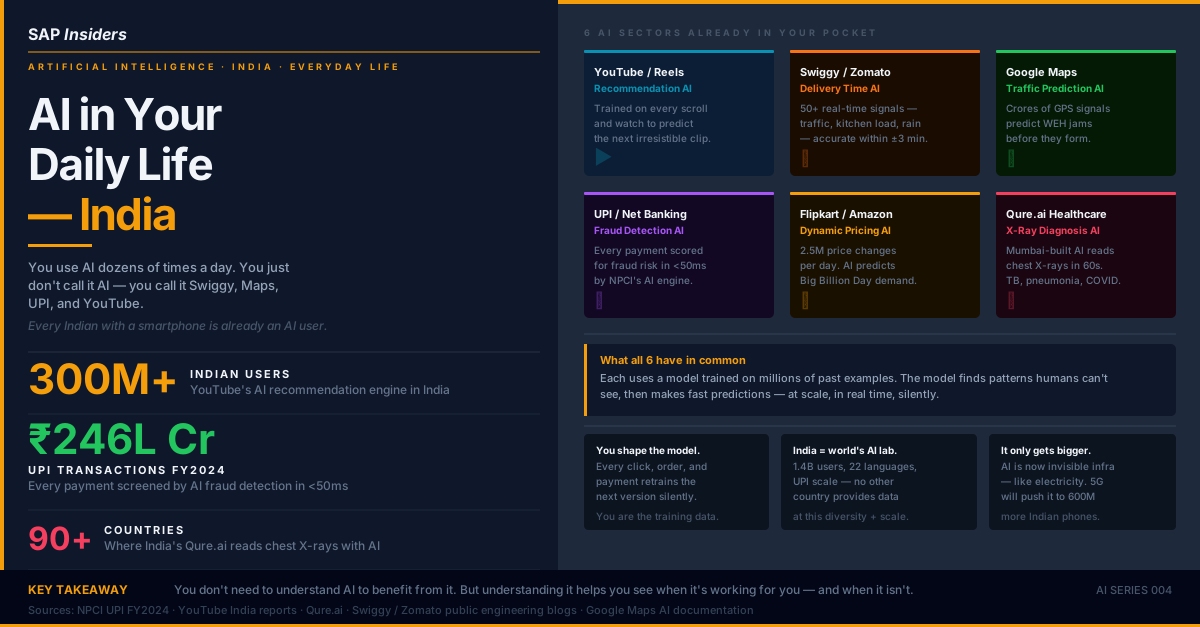
What AI is doing: Every action you take — which video you click, how long you watch, where you pause, which part you skip — is fed into a recommendation model. The model has learned from the behaviour of 300 million Indian users what kinds of videos tend to follow each other.
The system is not guessing. It is computing: given this user's last 50 watch actions, what video has the highest probability of producing a long watch time and a click on the next video?
The model weighs time of day, device type, language preference, what your friends in your social graph watch, seasonal trends (cricket tournament → cricket content rises), and hundreds of other signals. You never see this calculation. You just feel pulled.
The Indian angle: YouTube's recommendation model was reportedly retrained specifically on Indian user patterns because Indian viewing behaviour differs from US patterns — longer sessions on mobile, strong regional language preferences, different prime time hours. India forced a model update.
Why it matters: Recommendation engines are how most Indians now discover news, music, entertainment, and information. Understanding that this discovery is AI-curated — not neutral — changes how you should think about what you know.
Q: You and a friend open YouTube at the same time. You both search for "IPL 2026". Will you see the same results?
A: Almost certainly not. The recommendation model personalises results based on your individual history. Your friend might see more batting highlights; you might see more commentary analysis — because that is what you have historically watched longer.
2. Swiggy and Zomato — the delivery time prediction that's accurate within three minutes
What you experience: You order biryani at 12:45 PM. The app says "arriving in 32 minutes." It arrives at 1:17 PM. How did the app know?
What AI is doing: The estimated delivery time is not a guess. It is the output of a model that processes over 50 real-time signals simultaneously:
- Current kitchen queue at the restaurant (how many orders are already being prepared)
- Historical kitchen preparation time for this specific dish, on this day of the week, at this time
- Live traffic conditions on every segment of the route from restaurant to your door
- Weather conditions (rain slows riders by a predictable factor)
- Rider availability in your area right now
- Distance and road type
- Time of day (12:45 PM = peak lunch, shorter queue patience)
The model updates the estimate continuously as you wait. If a new order floods the kitchen or a traffic jam appears on the rider's route, the estimate adjusts.
The Indian angle: Swiggy reportedly trained its delivery time model specifically on Indian conditions — narrow lanes, flyover bottlenecks, auto-rickshaw traffic patterns, and the predictable chaos of cities like Bengaluru and Mumbai. An off-the-shelf Western logistics model simply does not account for these variables.
The model accuracy target: within ±3 minutes, 80% of the time. Achieving this at millions of orders per day across Tier 2 cities (Nagpur, Indore, Jaipur, Surat) where conditions are different from metro areas — is a genuinely hard ML problem.
Q: Swiggy's delivery estimate is 35 minutes. After 20 minutes, it suddenly jumps to 50 minutes. What likely happened?
A: The model detected a new signal — probably a kitchen delay (new rush of orders) or a traffic event on the rider's route. It recalculated and updated the estimate in real time rather than stick with the original prediction.
3. Google Maps — predicting traffic jams before they form
What you experience: Google Maps warns you: "Unusual traffic on the Western Express Highway. Leave 15 minutes earlier." You check the map. The highway looks clear. You leave early anyway. Twenty minutes later, the traffic appears exactly where Maps predicted.
What AI is doing: Google Maps knows traffic before you do because it is aggregating GPS traces from crores of Android phones simultaneously. When dozens of phones on a road segment suddenly slow down from 60 km/h to 15 km/h, the system detects this in near real time.
But prediction is harder than detection. To warn you before the jam forms, Maps uses:
- Historical traffic patterns for this road, this day, this time of year
- A comparison with traffic patterns that historically preceded jams
- Current event data (cricket match ending at a nearby stadium, school dismissal, religious procession)
- Weather data (rain → predictable slowdown factor on specific road types)
The result is a prediction — not a certainty, but a probability that the model has learned correlates with actual traffic 85%+ of the time.
The Indian angle: Indian road networks present unique challenges: roads that officially exist but are blocked by encroachment, unofficial shortcuts through neighbourhoods, festival-related closures not in any database, and the sheer volume of two-wheelers that move differently from cars.
Google has reportedly incorporated data from auto-rickshaws and bikes specifically for Indian maps accuracy — because following only car GPS traces misses how Indian traffic actually flows.
4. UPI and Net Banking — fraud detection that operates in under 50 milliseconds
What you experience: You send ₹12,000 to a new contact using PhonePe. The payment goes through in two seconds. You feel nothing. But something important happened in the background.
What AI is doing: Every UPI transaction passes through the National Payments Corporation of India (NPCI) fraud risk scoring system. This is a real-time ML model that assigns a fraud probability score to each transaction before it is settled.
The model looks at:
- Is the recipient a new payee or a known contact?
- Is the amount unusual for this sender's history?
- Is the sender's device the same device they always use?
- Is the transaction happening at an unusual time (3 AM)?
- Has this recipient received many small transactions in the last hour? (Mule account pattern)
- Is the sender's location consistent with their usual geography?
- Has this sender recently reported a suspicious call? (SIM swap pattern)
All of this scoring happens in under 50 milliseconds — before you even see the confirmation screen.
The scale: In FY2024, UPI processed approximately ₹246 lakh crore (₹246 trillion) across 131 billion transactions. That is roughly 4,200 transactions per second, every second, year-round. The fraud model runs on every single one.
The Indian angle: India's UPI is the largest real-time payment system in the world by transaction volume. The fraud patterns it encounters — SIM swap scams, OTP phishing, vishing (voice phishing) in regional languages — are specific to Indian social engineering methods. The model has to be trained on Indian attack vectors, not Western ones.
Q: Your elderly uncle's phone was used by a scammer to transfer ₹2 lakh to an unknown account at 11 PM. The bank says the transaction was "approved." Does that mean the fraud model missed it?
A: Not necessarily. Fraud models set a threshold, not a binary rule. A transaction with a 0.35 fraud score might be allowed through (to avoid blocking legitimate payments) while one scoring 0.80 is blocked. The model might have flagged it with a medium score but not blocked it automatically — the bank's threshold settings determine the cutoff.
5. Flipkart and Amazon India — dynamic pricing and demand forecasting at crore-item scale
What you experience: You look at a pair of running shoes on Flipkart. The price is ₹2,499. You add it to your wishlist. You come back two days later. The price is ₹2,799. You buy it immediately before it rises further.
What AI is doing: Prices on major Indian e-commerce platforms change approximately 2.5 million times per day. This is not a human team monitoring competitor prices and manually adjusting. It is an automated pricing model.
The model tracks:
- Competitor prices across Amazon, Meesho, Myntra in real time
- Current inventory levels for this SKU in each fulfilment centre
- Historical demand elasticity for this category (how much does demand drop when price rises ₹200?)
- Seasonal signals (monsoon approaching → raincoats rise, outdoor footwear falls)
- User-specific data (if you have viewed this item 4 times, your price sensitivity model is different from a first-time viewer)
- Cart abandonment rates at various price points
Demand forecasting for Big Billion Days: Before Flipkart's Big Billion Day sale, the company runs demand forecasting models weeks in advance to determine which products to pre-stock in which city warehouses. Getting this wrong means either unsold inventory (expensive) or out-of-stock items during the sale (even more expensive).
These models use historical Big Billion Day data, social trend signals, marketing spend projections, and regional consumption patterns to predict SKU-level demand for millions of products across 50+ Indian cities simultaneously.
The Indian angle: Indian pricing elasticity varies dramatically by state, language, product category, and even day of week around salary cycles. A pricing model calibrated for Delhi may perform poorly in Kolkata. Indian e-commerce AI has had to learn regional consumer behaviour at a granularity that Western platforms were not built to handle.
6. Qure.ai — an Indian AI reading chest X-rays in 60 seconds
What you experience: Nothing, unless you live near one of the 3,500+ facilities in India that now use Qure.ai. In that case, when a radiologist reads your chest X-ray, an AI has already pre-read it and marked any areas of concern — TB, pneumonia, nodules, COVID-19 findings.
What AI is doing: Qure.ai is a Mumbai-based healthcare AI company (founded 2016) that trained a deep learning computer vision model on millions of annotated chest X-rays. The model has learned what tuberculosis looks like on an X-ray, what normal tissue looks like, what pneumonia infiltrates look like — across a large population of South Asian patients whose physiology and disease presentations may differ from Western datasets.
The model reads a chest X-ray in approximately 60 seconds and produces:
- A structured report flagging specific findings by location in the lung
- A priority score (urgent review needed / routine)
- Overlaid annotations on the image showing where the finding is located
Why this matters in India specifically: India has the world's highest TB burden — approximately 2.5 million new TB cases per year. Many are in rural areas where radiologist access is limited. A government primary health centre may see a radiologist once a week. Qure.ai allows the X-ray to be uploaded, read by AI in 60 seconds, and a priority flag sent to the visiting radiologist's phone before they even arrive.
The AI is not replacing the radiologist. It is acting as a first-pass reader that ensures no obvious finding gets missed between radiologist visits.
The scale: As of 2025, Qure.ai has deployed in 90+ countries and partnered with India's central TB elimination programme. It has read over 10 million X-rays — more than any individual radiologist could see in a lifetime.
Q: A Qure.ai report says "no significant findings." A radiologist then looks at the same X-ray and spots a small nodule. Who is right?
A: The radiologist. AI medical tools are screening aids, not diagnostic authorities. The radiologist's clinical judgement always supersedes the AI finding. In practice, Qure.ai's role is to catch obvious positive cases that should not be missed — it is optimised for high recall (don't miss findings) at the cost of some precision (occasional false positives that the radiologist then rules out).
What all six have in common
Each of these applications uses a fundamentally similar approach:
- Collect data from millions of past events (past orders, past payments, past videos watched, past X-rays labelled by doctors)
- Train a model to find patterns in that data that humans cannot manually see
- Deploy the model to make fast predictions on new, unseen cases
- Update the model continuously as new data arrives
None of these require the model to "understand" in the human sense. YouTube's recommendation model does not understand why you like cooking videos. Swiggy's model does not understand traffic. Qure.ai does not understand lungs.
They predict — based on pattern matching at an enormous scale that human experts cannot replicate manually, at the speed and volume required for real-world deployment.
Why India is one of the world's most important AI deployment environments
India is unique as an AI environment for three reasons:
Scale without precedent. 1.4 billion users, 700 million smartphone users, 131 billion UPI transactions per year. No other country provides this volume of structured transaction data in one legal and linguistic jurisdiction.
Diversity that breaks standard models. 22 scheduled languages, 720+ dialects, wildly varying literacy rates, Tier 1 to Tier 4 city dynamics, multiple numbering systems (lakh/crore vs. international), multiple scripts (Devanagari, Tamil, Bengali, Telugu…). A model trained on English US data and deployed in India without adaptation will perform poorly on many use cases.
Urgency of problems being solved. India's TB burden, rural healthcare access gaps, agricultural productivity challenges, financial inclusion for 200 million unbanked adults — these are problems where AI can help at scale in ways that traditional approaches cannot.
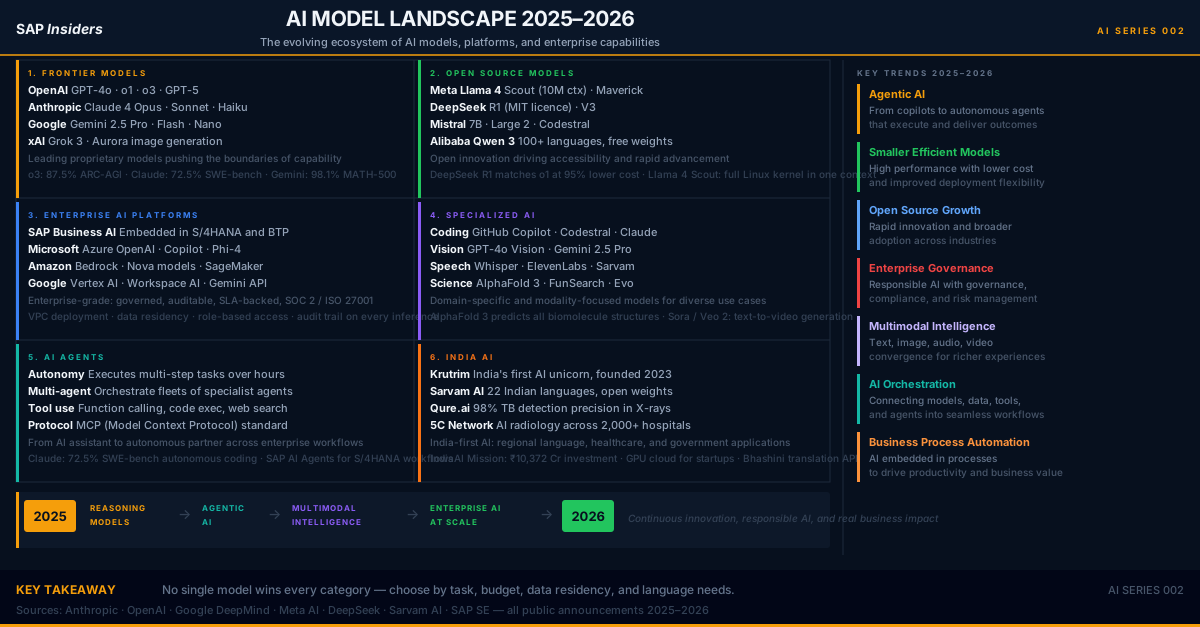
This is why Krutrim (built by Ola's Bhavish Aggarwal), Sarvam AI (fine-tuning open models for 10 Indian languages), and Qure.ai are not just Indian success stories. They are responses to genuine needs that Western-trained models could not fully address.
How to think about AI you cannot see
The most important shift this series is trying to create is not technical literacy — it is sceptical curiosity.
When Swiggy shows you a 32-minute estimate, ask: what is it not measuring?
When YouTube shows you your next video, ask: is this what I want, or what the model predicts will keep me engaged longest?
When UPI flags a transaction as suspicious, ask: what false positive rate is acceptable, and who decided that?
When Qure.ai says no findings, ask: at what accuracy was this model validated, and on what population?
None of these questions require a data science degree. They require the same healthy scepticism you would apply to any recommendation — from a shop assistant, a travel agent, or a doctor.
AI systems are built by people with constraints, incentives, and imperfect data. Understanding that they exist, and roughly how they work, is the first step to using them well.
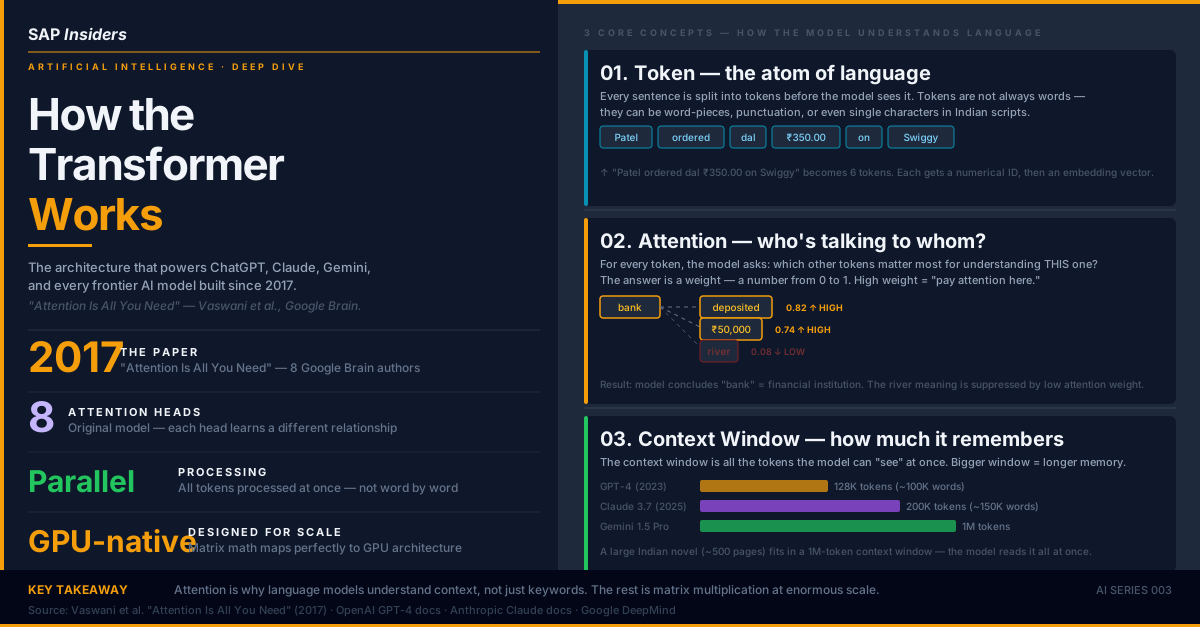
This is article 4 in the SAP Insiders AI series. Previous articles: The 70-Year Journey of AI · Every Major AI Model 2025–2026 · How the Transformer Works.