What it is:
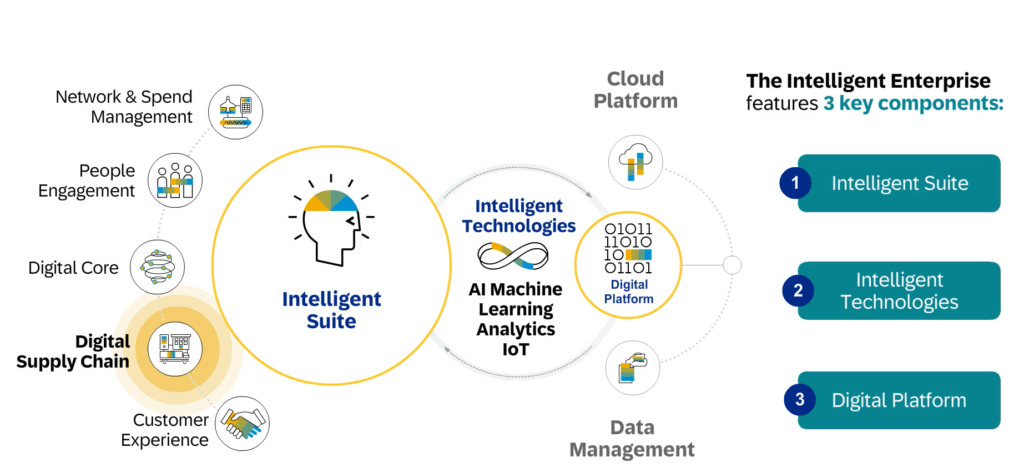
The Intelligent Enterprise is SAP’s strategy to help organizations use advanced technologies and best practices to become more agile, customer-focused, and efficient.
Why it matters:
It connects all business areas using data, automation, and AI to make smarter decisions and deliver better outcomes.
How it works (3 Key Components):
- Intelligent Suite
End-to-end applications (like Digital Core, Supply Chain, Customer Experience) to manage business processes. - Intelligent Technologies
Use of AI, Machine Learning, IoT, Analytics to automate, predict, and improve decisions. - Digital Platform
Underlying Cloud & Data Management platform for integration, security, and scalability.
SAP Business Technology Platform (SAP BTP)
What it is:
SAP BTP is a Platform-as-a-Service (PaaS) that enables you to develop, extend, and integrate business applications in the cloud.
Why it's important:
It powers the Digital Platform part of SAP’s Intelligent Enterprise. It allows innovation using AI, ML, IoT, Big Data, and supports flexible deployment across global cloud providers.
How it works (Key Components):
- App Development & Integration:
Build/extend apps using Cloud Foundry, ABAP, Kyma. - User Experience:
SAP Fiori for consistent, responsive UI. - Security:
SAP Cloud Identity Services and secure integration. - Data & Analytics:
SAP Analytics Cloud, Master Data Integration, and domain models. - Deployment:
Available globally on SAP Data Centers and Hyperscalers like:- Microsoft Azure
- AWS
- Google Cloud
- Alibaba Cloud
SAP S/4HANA
SAP S/4HANA is an acronym for SAP Business Suite 4 of the HANA Database and is part of the Intelligent Suite within the Intelligent Enterprise.
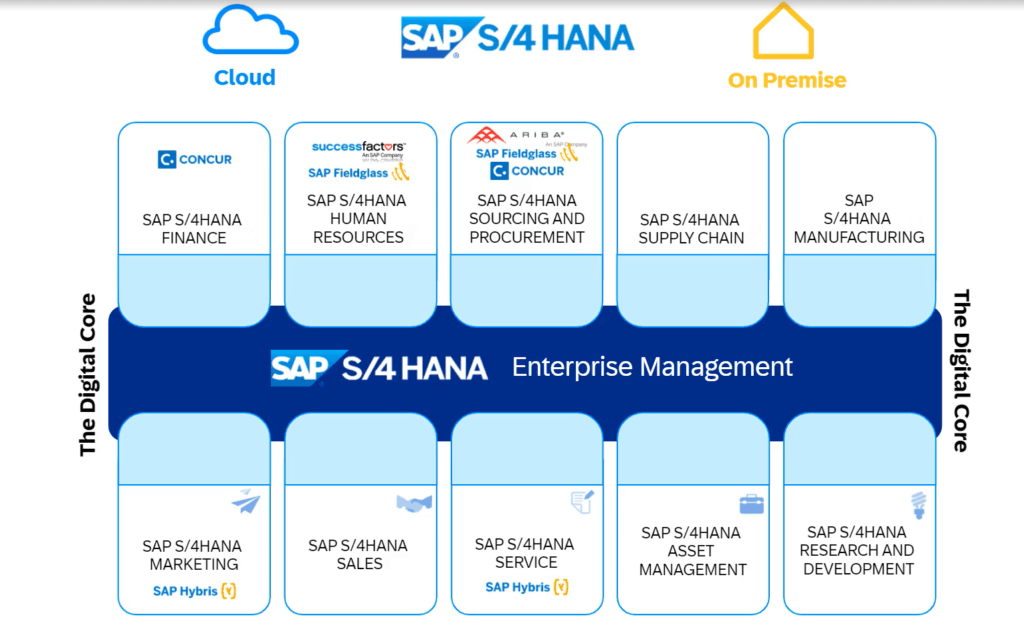
Understanding SAP S/4HANA Enterprise Management: The Digital Core of Modern Business
In today's competitive environment, organizations need an integrated system that brings efficiency, speed, and agility. SAP S/4HANA answers this need by acting as the Digital Core that connects all key business functions — across cloud and on-premise environments.
Key Business Areas within SAP S/4HANA
- Finance (with SAP Concur)
Real-time accounting, profitability analysis, and cost management — integrated with travel & expense automation. - Human Resources (SuccessFactors + Fieldglass)
Talent management and external workforce handling for a modern, hybrid workforce. - Sourcing & Procurement (Ariba + Concur + Fieldglass)
Source-to-pay processes optimized with supplier networks and external labor control. - Supply Chain
End-to-end visibility into logistics, warehousing, and demand planning. - Manufacturing
Smart factory and shop floor integration for quality, planning, and execution. - Marketing, Sales & Service (SAP Hybris)
Unified customer engagement across touchpoints, improving experiences and driving growth. - Asset Management
Manage physical assets efficiently, ensuring uptime and reduced operational costs. - Research & Development
Accelerate innovation with integrated design, development, and product lifecycle tools.
Cloud + On-Premise = Hybrid Flexibility
SAP S/4HANA supports both models:
- Cloud: Scalable, lower infrastructure costs, faster innovation.
- On-Premise: Full control, suitable for industries with regulatory constraints.
SAP S/4HANA offers flexible deployment options to cater to diverse business needs and IT strategies. Understanding these options is crucial for organizations planning their digital transformation journey. The primary deployment models include On-Premise, Cloud (Public and Private), Hybrid, and Mobile.
1. On-Premise Deployment
What: In this traditional model, the organization purchases a license and installs the SAP S/4HANA software in its own data center.
Why: This approach provides full control over the system, allowing extensive customization and adherence to specific security or regulatory requirements.
Considerations:
- Infrastructure Management: The organization is responsible for maintaining hardware, software, and network components.
- Customization: Offers the highest level of customization to align with unique business processes.
- Cost: Involves significant upfront investment in infrastructure and ongoing maintenance expenses.
2. Cloud Deployment
SAP S/4HANA Cloud deployment allows organizations to utilize SAP's capabilities without the need to manage physical infrastructure. This model is further divided into
a. Public Cloud
What: SAP hosts the software on a multitenant server, where multiple customers share computing resources.
Why: Offers cost efficiency and scalability, with SAP handling maintenance and updates.
Considerations:
- Standardization: Best suited for organizations willing to adopt standardized processes with minimal customization.
- Rapid Deployment: Enables quicker implementation timelines due to predefined configurations.
- Subscription Model: Operates on a subscription basis, reducing initial capital expenditure.
b. Private Cloud
What: The software is hosted on a dedicated server for a single organization, providing a balance between customization and cloud benefits.
Why: Combines the flexibility of on-premise systems with the advantages of cloud infrastructure.
Considerations:
- Customization: Allows for more tailored configurations compared to the public cloud.
- Control: Offers greater control over data and system changes.
- Managed Services: SAP or a chosen hyperscaler partner manages the infrastructure, reducing the internal IT burden
3. Hybrid Deployment
What: Integrates both on-premise and cloud solutions, enabling data and process sharing between the two environments.
Why: Provides flexibility to maintain critical systems on-premise while leveraging cloud innovations for other functions.
Considerations:
- Integration Complexity: Requires robust integration strategies to ensure seamless operation between environments.
- Phased Migration: Facilitates a gradual transition to the cloud, allowing organizations to move workloads at their own pace.
4. Mobile Deployment
What: Enables access to SAP S/4HANA applications via mobile devices, enhancing workforce mobility and productivity.
Why: Supports real-time decision-making and operations from any location.
Considerations:
- User Experience: Requires responsive and intuitive interfaces optimized for mobile use.
- Security: Necessitates robust security measures to protect data accessed through mobile devices.
Choosing the appropriate deployment option depends on various factors, including business objectives, IT capabilities, budget constraints, and regulatory requirements. Organizations should conduct a thorough assessment to determine the model that best aligns with their strategic goals and operational needs.
Two-Tier ERP Deployment
Two-Tier ERP means running one main ERP (Tier 1) at HQ and a lighter ERP (Tier 2) for subsidiaries or smaller units. It helps balance central control with local flexibility.
Example:
A global company like Adidas uses:
- Tier 1: SAP S/4HANA On-Premise at headquarters (Germany)
- Tier 2: SAP S/4HANA Cloud for local branches (e.g., India, Brazil) for sales, procurement, and reporting